
The Chemistry Student Who Couldn’t Forget
Last spring, I watched Maria struggle through our unit on chemical bonding. She’d stare at her notes about ionic and covalent bonds, muttering formulas under her breath, only to blank out completely during quizzes. Then something clicked during our review session. Instead of memorizing that sodium gives up an electron to chlorine, she started picturing sodium as a generous friend who always lends money, while chlorine was the friend who gratefully accepts and holds onto every penny. Suddenly, NaCl wasn’t just a formula, it was a story about two very different personalities forming the perfect partnership.
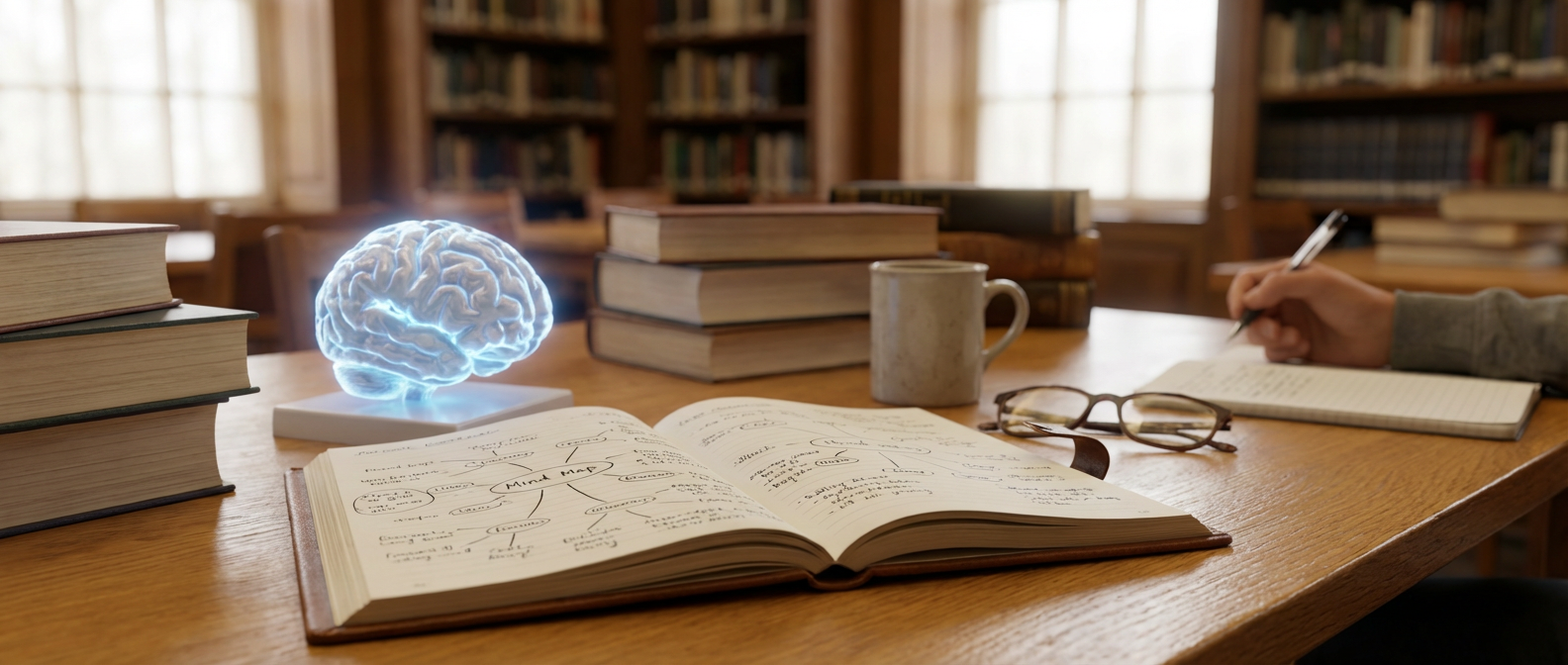
Maria’s breakthrough wasn’t accidental. Her brain had stumbled onto one of the most powerful learning tricks around: turning abstract information into concrete, memorable stories. When she gave those elements human characteristics, she activated multiple neural pathways at once. Her visual cortex painted the scene, her emotional centers connected with the friendship metaphor, and her language processing areas wove it all into a coherent story. Three weeks later, she aced her chemistry final, confidently explaining electron transfer as if she were describing old friends.
This transformation reveals something profound about how memory actually works. Our brains didn’t evolve to memorize isolated facts or abstract formulas. They evolved to remember stories, relationships, and spatial information that kept our ancestors alive. When you force your mind to process disconnected information, you’re working against millions of years of evolution. But when you tap into your brain’s natural storytelling machinery, learning becomes not just easier, but actually enjoyable.

Building Your Mental Architecture: The Method of Loci
Picture walking through your childhood home. You can probably navigate from the front door to your old bedroom without conscious effort, remembering where the squeaky floorboard sits and which light switch controls what fixture. This spatial memory is one of your brain’s most reliable storage systems, and you can use it deliberately through the ancient method of loci, also called the memory palace technique.
Here’s how it works in practice. Choose a familiar route, your daily walk to the coffee shop, your path through the grocery store, or even the layout of your favorite video game level. This becomes your mental framework. Now, as you encounter new information you need to remember, you strategically place vivid, often absurd images along this familiar path. The more bizarre and emotionally engaging these mental images, the better they stick.
Consider how Jake, one of my AP Biology students, memorized the stages of mitosis. He mapped them onto his walk from his dorm room to the campus library. At his door, he visualized DNA replication as his twin roommates making identical copies of their homework. Walking down the hallway, he imagined chromosomes lining up like students waiting for the cafeteria to open. At the library entrance, he pictured the chromosome pairs splitting up like couples after an argument, each walking to opposite ends of the building. By the time he reached his favorite study spot, he had mentally walked through prophase, metaphase, anaphase, and telophase in a sequence he couldn’t forget.
The beauty of this technique lies in its reliability. Unlike rote memorization, which depends on perfect recall of abstract sequences, the method of loci gives you multiple retrieval cues. If you forget one image, the spatial sequence guides you to the next landmark, where another vivid scene awaits. You’re not just memorizing facts, you’re creating a mental journey that becomes more detailed and automatic with each review.
The Power of Active Recall: Testing Your Way to Mastery
Sarah spent hours highlighting her psychology textbook in rainbow colors, convinced she was studying effectively. Her notes were works of art, perfectly organized, color-coded, and beautifully written. Yet when exam day arrived, she struggled to recall information that felt familiar but remained frustratingly out of reach. She had fallen into one of the most common learning traps: mistaking recognition for actual knowledge.
The solution lies in active recall, a deceptively simple technique that transforms passive review into powerful learning. Instead of re-reading your notes for the fifth time, close your textbook and write down everything you remember about the topic. Create practice questions and answer them without peeking at your materials. Explain concepts out loud as if teaching them to someone else. This process forces your brain to reconstruct information from memory rather than simply recognizing it on a page.
Research consistently shows that this approach, though initially more challenging, produces dramatically better long-term retention. When you struggle to retrieve information from memory, you strengthen the neural pathways that lead to that knowledge. Each successful recall makes the next retrieval faster and more reliable. Think of it like blazing a trail through a forest. The more often you walk the same path, the clearer and more permanent it becomes.
The key is embracing the difficulty. When Sarah started using active recall, her study sessions felt harder at first. She couldn’t coast through familiar material or rely on the false confidence that comes from re-reading highlighted passages. But within weeks, she noticed something remarkable: information that previously slipped away after exams now stuck with her months later. She was building genuine understanding rather than temporary familiarity.
Spaced Repetition: The Science of Perfect Timing
Thomas was frustrated with his Spanish vocabulary progress. He’d drill the same word lists every night, feeling confident after each session, only to discover that words he “knew” the evening before had vanished by morning. His approach reflected a common misconception about memory: that intensive, massed practice produces the best results. In reality, he was working against one of memory’s basic principles.
Memory strength follows a predictable decay curve. Without reinforcement, newly learned information fades rapidly. You might retain 60% after an hour, 40% after a day, and perhaps 20% after a week. But here’s the counterintuitive part: reviewing information just as it begins to fade creates much stronger memory traces than reviewing it while it’s still fresh. This principle, called spaced repetition, transforms forgetting from an enemy into a learning ally.
The optimal review schedule expands gradually. You might review new vocabulary words after one day, then three days, then a week, then two weeks, then a month. Each time you successfully recall information that was beginning to fade, you extend its staying power exponentially. Modern spaced repetition systems like Anki automate this scheduling, but you can implement the principle with simple flashcards or a basic calendar system.
When Thomas shifted to spaced repetition, his vocabulary retention transformed dramatically. Instead of cramming 50 new words each night and forgetting most of them, he introduced 10 new words daily while systematically reviewing older vocabulary at optimal intervals. Six months later, he had accumulated over 1,000 words that he could recall reliably, compared to the few dozen that previously stuck using his old massed practice approach. The secret wasn’t studying harder, it was studying smarter, working with his brain’s natural rhythms rather than against them.
Connecting the Dots: Building Your Personal Learning System
These techniques work together, each amplifying the others’ effectiveness. Start by transforming your most challenging material into vivid stories or spatial journeys. Use active recall to test your memory palace navigation and story details regularly. Apply spaced repetition to ensure these mental constructions grow stronger over time rather than fading away.
Remember that building these skills takes patience and practice. Your first memory palace might feel awkward, your initial attempts at active recall might seem frustratingly difficult, and your spacing intervals might need adjustment. This is normal and expected. Like Maria discovering her sodium and chlorine friendship or Jake walking through mitosis, your breakthrough moments will come when you find the specific applications that work for your learning style and subject matter.
I’d love to hear about your own experiences with these memory strategies. Which techniques have you tried? What subjects are you working to master? Share your stories and questions in the comments below. Your insights might be exactly what another learner needs to hear.
