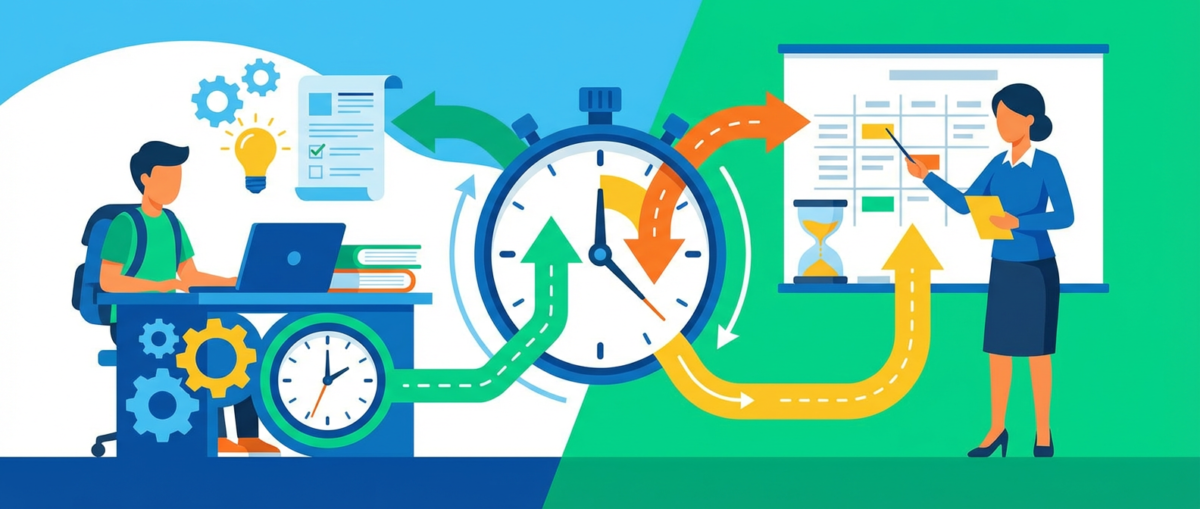
Why Traditional Time Management Falls Apart in Educational Settings
I’ve watched countless students dutifully color-code their planners and download the latest productivity apps, only to abandon them within weeks. Here’s what the research tells us about why this happens: our brains don’t naturally think in abstract time blocks. Cognitive load theory shows us that when we’re learning something new, our working memory gets overwhelmed trying to juggle both the content we’re studying and the complex time management system we’ve imposed on ourselves.
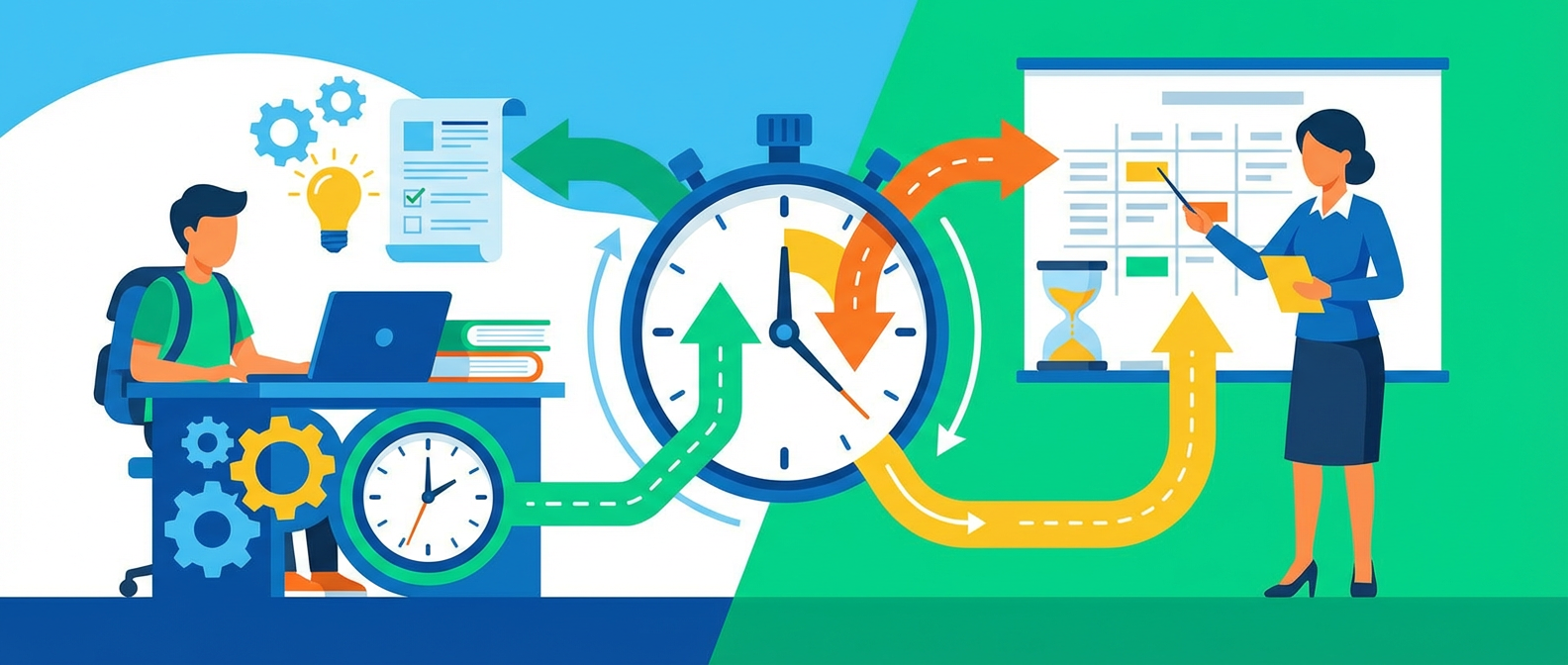
The neuroscience here is honestly fascinating. Time perception happens in the prefrontal cortex, the same brain region responsible for executive functions like planning and decision-making. When this area is already taxed by learning new material, adding complicated scheduling demands creates what researchers call “cognitive interference.” It’s like trying to solve a math problem while someone reads you a grocery list. Your brain simply can’t process both streams of information well.
This explains why students often feel more scattered after implementing elaborate time management systems. They’re not failing at discipline. They’re experiencing a predictable neurological bottleneck. The solution isn’t more complex systems but rather approaches that work with how our brains actually process time and learning, not against them.

The Spacing Effect: Your Secret Weapon for Sustainable Scheduling
Hermann Ebbinghaus discovered something remarkable in 1885 that completely changes how we should think about study time. Information sticks better when learning sessions are spaced out over time rather than crammed together. This “spacing effect” isn’t just about memory retention. It fundamentally changes how we should structure our days and weeks.
When you space out your learning sessions, your brain interprets the gaps as evidence that the information is important enough to remember long-term. During these intervals, a process called “consolidation” moves information from temporary storage in your hippocampus to more permanent storage in your cortex. This isn’t passive time. Your brain is actively strengthening neural pathways even when you’re not consciously thinking about the material.
Here’s how this translates into practical scheduling: instead of blocking three hours for chemistry on Sunday, schedule 45-minute sessions on Monday, Wednesday, and Friday. Your brain will retain more information with less total study time. I think about this with my own learning all the time. For educators, this means designing curricula that deliberately revisit concepts across multiple classes rather than covering everything about photosynthesis in one marathon lesson.
The beauty of spacing-based scheduling is that it naturally prevents the overwhelm that derails most time management attempts. You’re working with your brain’s natural learning rhythms instead of fighting against them.
Attention Restoration Theory: Why Breaks Aren’t Laziness
Rachel and Stephen Kaplan’s attention restoration theory reveals something important about how our cognitive resources actually work. Our brains have two types of attention: directed attention, which requires effort and gets depleted with use, and effortless attention, which naturally restores our mental energy. This isn’t about willpower or motivation. It’s about understanding that attention is a finite resource that follows predictable patterns of depletion and recovery.
The research is clear: students who take regular breaks in natural settings or engage in activities that require effortless attention actually perform better on subsequent cognitive tasks than those who push through without breaks. This happens because different types of mental activities use different neural networks. When you’re deeply focused on calculus, you’re primarily using your central executive network. When you step outside and watch clouds or listen to music, you activate your default mode network, which gives the executive network time to recover.
For students, this means building “restoration breaks” into your schedule isn’t procrastination. It’s strategic cognitive management. A ten-minute walk between study subjects isn’t lost time. It’s an investment in your brain’s ability to focus during the next session. For educators, this research supports shorter class periods with movement breaks, or even brief mindfulness moments that allow students’ directed attention to reset.
The Power of Implementation Intentions in Educational Contexts
Peter Gollwitzer’s research on implementation intentions offers one of the most practical applications of behavioral psychology to time management. Instead of vague goals like “study more,” implementation intentions follow a specific “if-then” format: “If it’s 7 PM on Tuesday, then I will review my chemistry notes for 30 minutes at the kitchen table.” This simple structure dramatically increases follow-through rates because it removes decision-making from the moment of action.
The cognitive science behind this is elegant. Decision-making depletes the same mental resources we use for learning and focusing. When students have to decide when, where, and how to study every single time, they’re using precious cognitive energy before they even open a textbook. Implementation intentions make these decisions ahead of time, preserving mental resources for the actual learning.
In practice, this looks like creating specific “if-then” statements for your most important academic routines. “If I finish lunch, then I review my morning notes for ten minutes before the afternoon class begins.” “If I sit down at my desk after dinner, then I start with the most challenging subject while my focus is strongest.” These aren’t rigid rules. They’re cognitive shortcuts that make good choices automatic.
For educators, implementation intentions can transform classroom management. “If students enter the room, then they immediately begin the warm-up problem on the board.” This removes the daily negotiation about what to do first and creates a smooth transition into learning mode.
Building Time Awareness Through Metacognitive Reflection
One of the most overlooked aspects of time management is developing accurate time estimation skills. Most students dramatically underestimate how long tasks will take, leading to chronic overwhelm and poor planning. This isn’t a character flaw. It’s a predictable cognitive bias called the planning fallacy, identified by Daniel Kahneman and Amos Tversky.
The solution involves what researchers call “metacognitive monitoring.” Essentially, developing awareness of your own thinking and learning processes. When students regularly reflect on how long tasks actually took compared to their estimates, they gradually develop more accurate time intuition. This isn’t about perfect prediction. It’s about reducing the gap between expectation and reality.
Try keeping a simple learning log for one week. Before starting any study session, estimate how long it will take. Afterward, note the actual time spent and what factors influenced the difference. Did you get distracted by your phone? Did the material prove more complex than expected? Did you need to look up background concepts? This reflection builds what researchers call “temporal metacognition,” awareness of how you experience time during different types of learning activities.
What emerges from this practice is profound: you begin to see patterns in your own learning rhythms. You might discover that you consistently underestimate reading time but overestimate math problem-solving time. This self-knowledge is the foundation for realistic scheduling that actually supports your learning instead of setting you up for failure.
These evidence-based approaches to time management aren’t about achieving perfect productivity or eliminating all stress from learning. They’re about working intelligently with the cognitive realities of how brains actually process information and time. What questions do you have about implementing these research-backed strategies in your own learning environment?
