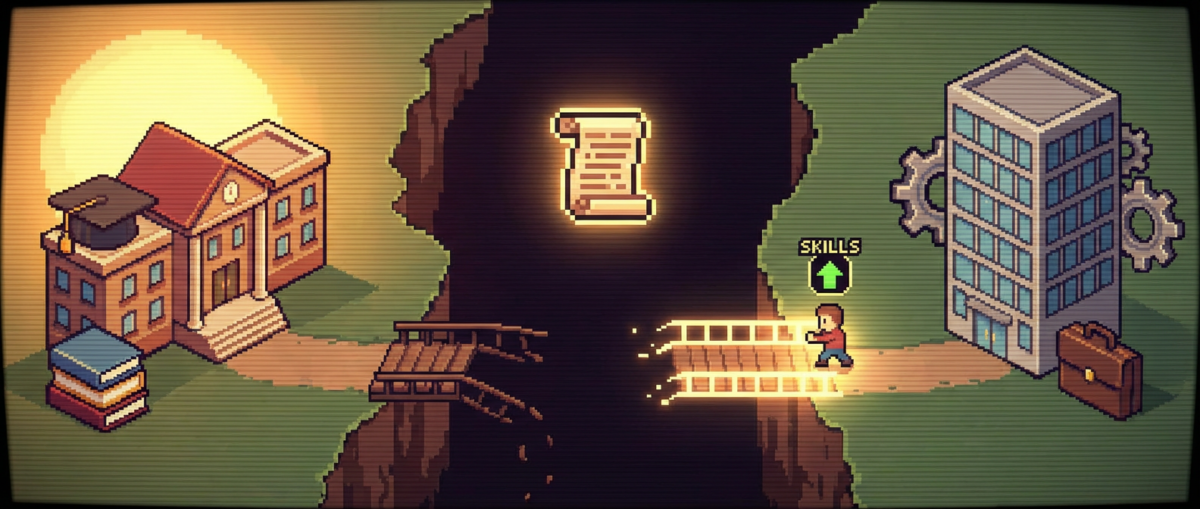
The Skills Gap Has Become a Skills Chasm
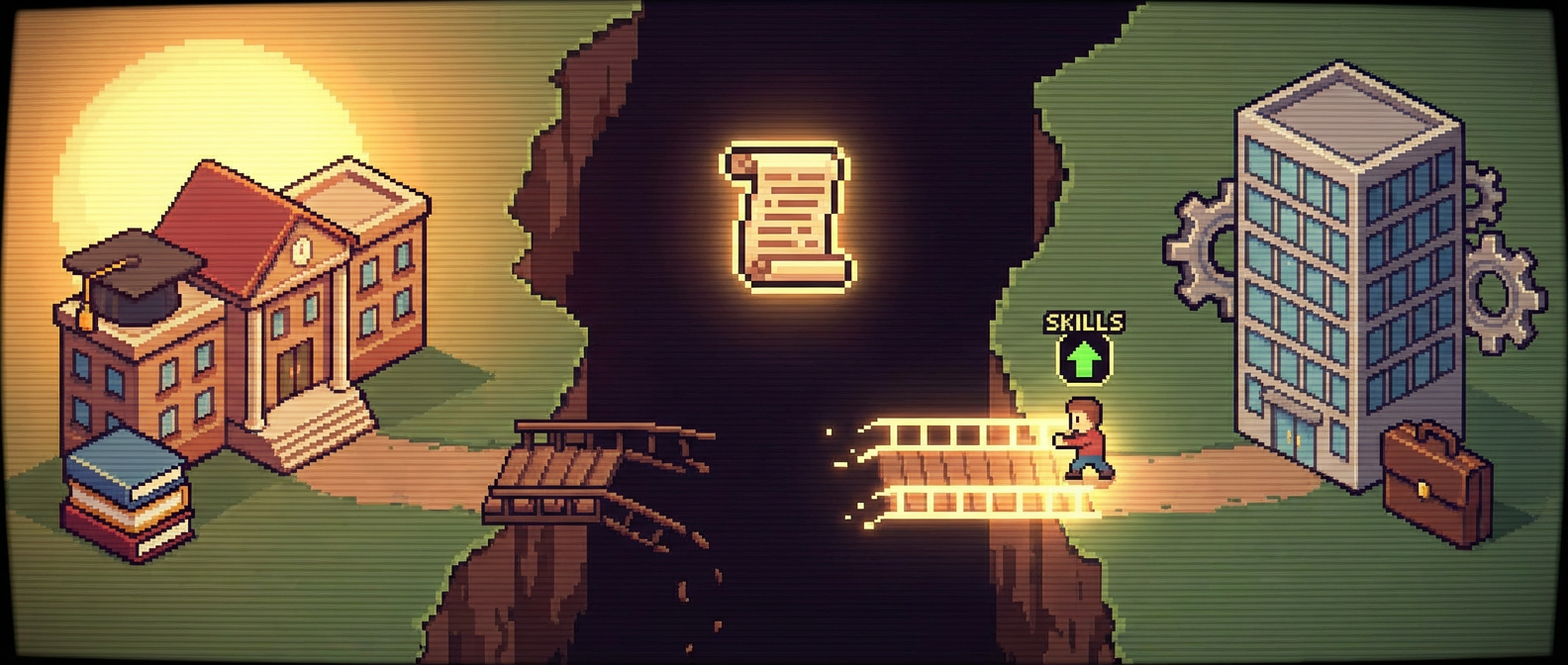
I want to tell you something I’ve been watching unfold in real time, and it’s kept me up at night more than once. The distance between what universities are teaching and what the job market actually demands has grown so wide that a four-year degree now feels less like a bridge to employment and more like arriving at the airport only to discover the runway was built in a completely different direction.
The Coursera Global Skills Report 2025 analyzed learning patterns across 140 million learners in 101 countries, and the findings are striking in how consistent they are. Artificial intelligence literacy has surfaced as the number one skills gap across every single global region for the first time in the report’s history. This isn’t a regional anomaly or a trend confined to Silicon Valley. This is systematic. This is now.
But here’s what really caught my attention: only 29 percent of college graduates who finished their degrees in 2025 reported receiving any formal instruction in generative AI tools throughout their entire four-year program. Think about that number for a moment. We’re sending young people into a labor market transformed by AI, and nearly three-quarters of them never once sat in a classroom where someone taught them how to actually use these tools. The curriculum hasn’t caught up. It’s not even close.

Understanding Why the System Broke Down
This isn’t anyone’s fault, exactly. It’s a systems design problem, and those are always more complicated than individual blame allows. Universities operate on long planning cycles. Curriculum development takes years. By the time a new major is approved, the technology landscape has already shifted twice. The people designing computer science programs in 2022 were building toward a world that looked fundamentally different from 2025.
But there’s something else happening too, something that reveals a deeper structural issue. Colleges have traditionally validated their curriculum through academic frameworks and peer review within their own disciplinary communities. What they haven’t done historically is build tight feedback loops with employers. The people hiring knew the skills were missing. The people teaching often didn’t have real-time visibility into what that job market actually required. These two communities were speaking past each other.
The World Economic Forum Future of Jobs Report projects that 85 million jobs will be displaced by 2027 while 97 million new roles will simultaneously emerge. That’s not a gentle transition. That’s economic whiplash. And it’s happening at a pace that traditional institutional structures simply cannot match.
Who’s Already Bridging the Gap (And What We Can Learn)
Here’s where things get interesting, because solutions are already materializing. Arizona State University partnered with Coursera to create something genuinely novel: the first fully employer-validated online bachelor’s degree in Applied AI. Twelve thousand students enrolled in the first semester. Twelve thousand. That’s not a pilot program. That’s a signal that there’s real hunger for credentials designed in conversation with the people actually hiring.
The distinction matters enormously. This degree wasn’t built by academics working in isolation, then shopped to employers afterward. It was built with employers from the beginning, validating each component, ensuring that every course actually mapped to skills that companies needed on day one. It’s a different architecture entirely.
I’m also watching something fascinating happen in the adult learner space. Enrollment in AI and machine learning courses among people aged 35 to 50 grew by 237 percent between 2024 and 2025. These are working professionals, many of them with established careers, recognizing that the ground has shifted beneath them. They’re not waiting for their colleges to figure it out. They’re actively reskilling, taking control of their own development in ways that feel urgent and self-directed.
Three Concrete Steps to Design Your Own Bridge
If you’re a student right now, or a parent watching this unfold, or someone in a career field you can feel transforming around you, you have more agency than you might think. First, stop treating your degree as a finished product that marks the end of your education. It’s the foundation, not the destination. Whatever your major, layer skills on top of it intentionally. If you’re in business, pick up applied data literacy. If you’re in liberal arts, learn to prompt engineer with AI tools. These aren’t distractions from your degree. They’re what make your degree actually relevant.
Second, build direct relationships with the people doing hiring in fields that interest you. This sounds simple, and it is, but it’s also genuinely rare. Informational interviews, coffee chats, LinkedIn conversations, industry conferences. The hiring manager knows what skills they’re struggling to find. Ask them. Then go learn those skills. You’ll end up with a skill set tailored to actual market demand instead of guessing based on a curriculum written three years ago.
Third, consider stackable credentials. A four-year degree plus an employer-validated certificate in a high-demand area isn’t a redundancy. It’s specificity. It’s proof that you can actually do the thing. When you combine rigorous academic training with demonstrated applied skill, you become genuinely competitive. The whole becomes more than the sum of the parts.
The System Will Eventually Adapt (But You Shouldn’t Wait)
Universities are innovating. I see it happening. The employer-validated degree model is spreading. More programs are building in regular curriculum reviews with hiring partners. Some universities are even creating fast-track certificate options alongside traditional degrees, allowing students to earn industry credentials while working toward their bachelor’s degree. These are thoughtful adaptations to a genuine structural problem.
But adaptation takes time, and the labor market isn’t waiting. You can’t assume that what your college is teaching you today will be sufficient for the job market you’re entering in three or four years. That was never really a safe assumption, but it’s absolutely not one now.
Here’s what I believe after thinking about this for a long time: the future belongs to people who view education as a continuous, self-directed process. Not in a way that’s exhausting or unsustainable, but in a way that’s realistic about how quickly things change. You’ll finish your degree, and then you’ll keep learning. You’ll identify skills gaps in your own field and address them. You’ll stay curious about what’s emerging. You’ll treat your education as something you’re actively designing rather than something that happened to you.
That’s not how most of us were taught to think about learning. We were taught that education was something that ended when you got your diploma. But the world has changed. The diploma is now a credential you earn, and then you keep building from there. What questions are you starting to notice about your own education right now? What skills do you see emerging in the fields that interest you? I’d genuinely love to hear what you’re observing. Share your thoughts below.
