Mascots conference

Educational content designed to spark curiosity and build real understanding.

Archives (page 9 of 11)

The Moment Sarah Realized Her Classroom Was Actually Running Itself

When the Magic Happens

Sarah stood at her classroom door during lunch, watching her third-graders organize themselves into reading groups without a single reminder. Marcus automatically grabbed the timer for silent reading. Emma distributed the pencil sharpener duty chart she’d made herself. No chaos. No raised voices. No pleading looks toward the teacher’s desk.

Three months earlier, this same classroom had felt like herding cats through a thunderstorm. Sarah had spent her planning periods researching behavior management systems, her evenings creating elaborate reward charts, and her weekends questioning whether she’d chosen the wrong profession. The transformation didn’t happen overnight, but it started with one realization: the best classroom management feels invisible because it prevents problems rather than reacting to them.

Building Your Foundation Before You Need It

The most effective classroom managers I know spend their first week teaching procedures, not content. Think of it like programming a computer. You wouldn’t expect software to run smoothly without clear code, yet many new teachers jump straight into lessons without establishing the underlying systems that make learning possible.

Start with your non-negotiables. For Sarah, these became her “Big Three”: respect for learning, respect for others, and respect for space. She practiced the pencil sharpener routine seventeen times on the first day because she knew that autumn’s smooth transitions depended on September’s repetitive rehearsals. When students asked “Can I sharpen my pencil?” she’d pause the entire class, demonstrate the proper procedure again, and have the student retry it correctly.

This might feel excessive, but consider the alternative. Every unclear expectation becomes a decision point later. When twenty-five students face the same unclear moment, you’ve just created twenty-five potential disruptions. Sarah learned to ask herself: “What will this look like when it’s working perfectly?” Then she taught toward that vision.

The Power of Strategic Attention

Here’s what veteran teachers know that textbooks rarely mention: attention is currency, and you control the exchange rate. When Tommy blurts out an answer, every eye in the room watches your response. Acknowledge it, and you’ve just bought more blurting. Ignore it while intentionally calling on the student with a raised hand, and you’ve invested in the behavior you actually want.

Sarah discovered this during a particularly challenging math lesson when Alex kept interrupting with jokes. Her instinct was to address him directly, but that meant pausing instruction and giving Alex exactly what he wanted: center stage. Instead, she developed what she called “strategic blindness.” She’d continue teaching while moving closer to Alex, sometimes placing a gentle hand on his desk. The interruptions stopped because they stopped working.

This doesn’t mean ignoring serious behavior issues. It means distinguishing between attention-seeking disruptions and genuine problems. The student who whispers during instructions needs a different response than the student who’s struggling to stay awake because they worked until midnight at their family’s restaurant.

Creating Systems That Think for Themselves

The smoothest classrooms run on autopilot because teachers have created systems that eliminate constant decision-making. Sarah’s breakthrough came when she stopped trying to control every moment and started designing structures that guided behavior naturally.

Her “materials manager” system shows how this works. Instead of students asking “Where’s the glue?” throughout the day, she assigned weekly rotating roles: supplies manager, technology helper, line leader, and cleanup coordinator. Students wore simple lanyards with their job titles. Suddenly, questions got answered by peers instead of creating interruptions. The supplies manager became the go-to person for materials, developing leadership skills while reducing Sarah’s cognitive load.

Transition time became another opportunity for systematic thinking. Sarah taught her students that when they heard the chime, they had exactly ninety seconds to complete their current task, clean their area, and prepare for the next activity. She’d count down the final thirty seconds aloud. Within two weeks, her class could transition between activities faster than most adults switch between emails.

Reading the Room Like a GPS

Effective classroom managers develop something like parental radar. They sense the energy shift when kids return from lunch too excited to focus immediately. They notice when the student who usually participates actively suddenly goes quiet. They feel the collective attention starting to wane during that tricky post-recess instructional block.

Sarah learned to read these signals and adjust accordingly. When her afternoon class showed signs of restlessness, she’d incorporate sixty seconds of jumping jacks or breathing exercises before diving into math. When individual students seemed off, she’d check in briefly during independent work time. “Everything okay today, Marcus? I noticed you seem tired.” Often, that simple acknowledgment was enough to reset their focus.

The key insight here is preventative intervention. Expert teachers address potential disruptions before they become actual disruptions. They see the student starting to fidget and quietly offer a sensory break. They notice two friends beginning to chat and smoothly redirect their attention to the task. This kind of classroom awareness develops with experience, but you can accelerate it by deliberately practicing observation during low-stakes moments.

Growing Into Your Management Style

Sarah’s biggest mistake early on was trying to copy her cooperating teacher’s authoritarian style instead of developing her own approach. What worked for a twenty-year veteran with a naturally commanding presence felt forced and artificial coming from a soft-spoken first-year teacher. Authentic classroom management aligns with your personality while maintaining clear expectations.

Some teachers thrive with detailed behavior tracking systems and public recognition charts. Others find success with quiet, individual conferences and private goal-setting. The magic isn’t in the specific strategy but in the consistency of application and the genuine care behind it. Students sense when teachers authentically believe in their potential versus when they’re just following a prescribed discipline program.

Your classroom management style will evolve as you gain confidence and learn your students’ needs. What matters most in your first year is establishing basic systems, staying consistent, and remembering that even veteran teachers have challenging days. The goal isn’t perfection but progress toward a classroom culture where learning can flourish.

What would your ideal classroom sound like during independent work time? What procedures could you practice tomorrow that would eliminate three common interruptions? Start there, and trust that the invisible magic of smooth classroom management will emerge from these very visible, very intentional building blocks.

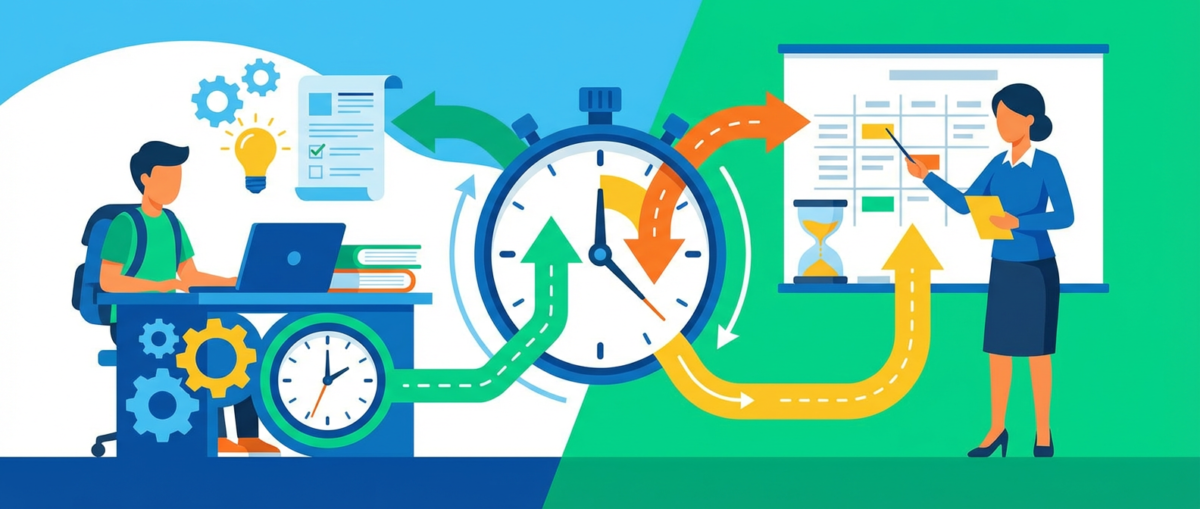
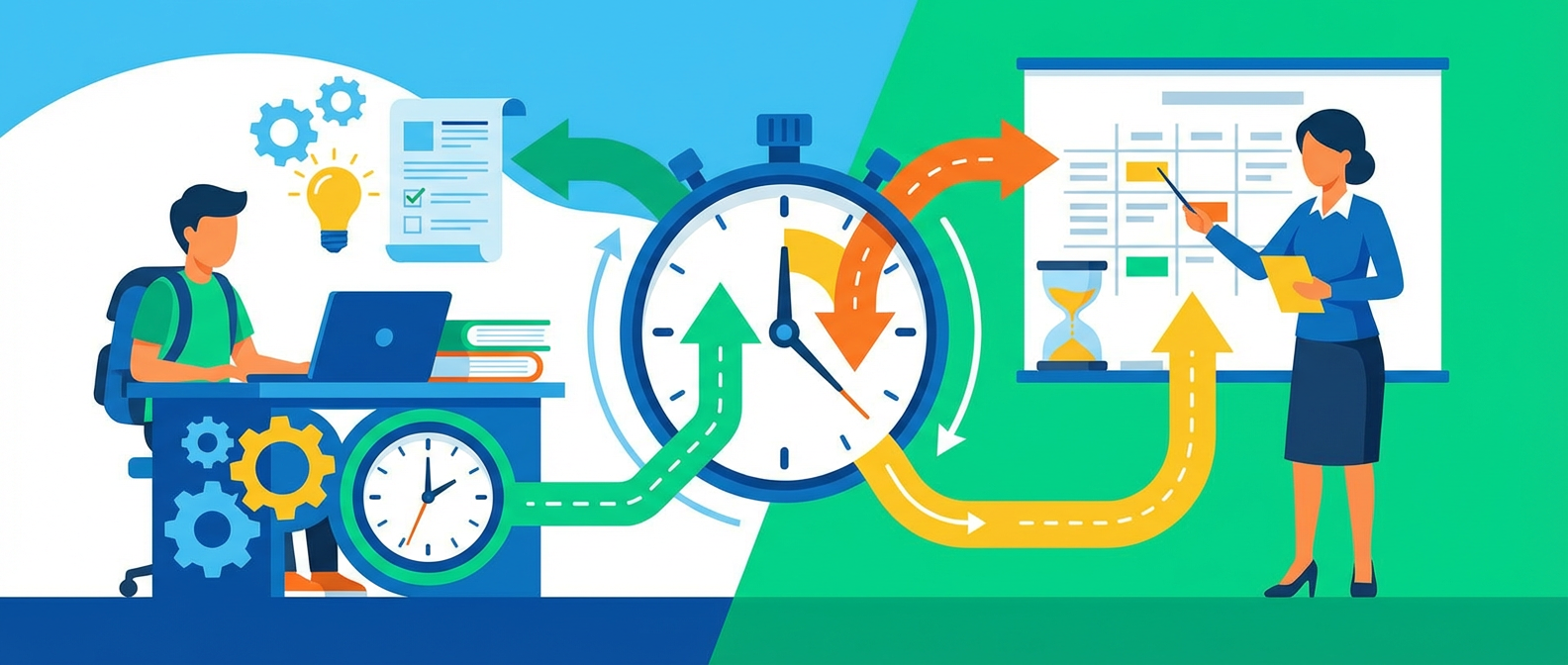
The Science of Time: How Your Brain Actually Learns to Manage Time (And Why Most Advice Misses the Mark)

Why Traditional Time Management Falls Apart in Educational Settings

I’ve watched countless students dutifully color-code their planners and download the latest productivity apps, only to abandon them within weeks. Here’s what the research tells us about why this happens: our brains don’t naturally think in abstract time blocks. Cognitive load theory shows us that when we’re learning something new, our working memory gets overwhelmed trying to juggle both the content we’re studying and the complex time management system we’ve imposed on ourselves.

The Science of Time: How Your Brain Actually Learns to Manage Time (And Why Most Advice Misses the Mark)

The neuroscience here is honestly fascinating. Time perception happens in the prefrontal cortex, the same brain region responsible for executive functions like planning and decision-making. When this area is already taxed by learning new material, adding complicated scheduling demands creates what researchers call “cognitive interference.” It’s like trying to solve a math problem while someone reads you a grocery list. Your brain simply can’t process both streams of information well.

This explains why students often feel more scattered after implementing elaborate time management systems. They’re not failing at discipline. They’re experiencing a predictable neurological bottleneck. The solution isn’t more complex systems but rather approaches that work with how our brains actually process time and learning, not against them.

Illustration for The Science of Time: How Your Brain Actually Learns to Manage Time (And Why Most Advice Misses the Mark)

The Spacing Effect: Your Secret Weapon for Sustainable Scheduling

Hermann Ebbinghaus discovered something remarkable in 1885 that completely changes how we should think about study time. Information sticks better when learning sessions are spaced out over time rather than crammed together. This “spacing effect” isn’t just about memory retention. It fundamentally changes how we should structure our days and weeks.

When you space out your learning sessions, your brain interprets the gaps as evidence that the information is important enough to remember long-term. During these intervals, a process called “consolidation” moves information from temporary storage in your hippocampus to more permanent storage in your cortex. This isn’t passive time. Your brain is actively strengthening neural pathways even when you’re not consciously thinking about the material.

Here’s how this translates into practical scheduling: instead of blocking three hours for chemistry on Sunday, schedule 45-minute sessions on Monday, Wednesday, and Friday. Your brain will retain more information with less total study time. I think about this with my own learning all the time. For educators, this means designing curricula that deliberately revisit concepts across multiple classes rather than covering everything about photosynthesis in one marathon lesson.

The beauty of spacing-based scheduling is that it naturally prevents the overwhelm that derails most time management attempts. You’re working with your brain’s natural learning rhythms instead of fighting against them.

Attention Restoration Theory: Why Breaks Aren’t Laziness

Rachel and Stephen Kaplan’s attention restoration theory reveals something important about how our cognitive resources actually work. Our brains have two types of attention: directed attention, which requires effort and gets depleted with use, and effortless attention, which naturally restores our mental energy. This isn’t about willpower or motivation. It’s about understanding that attention is a finite resource that follows predictable patterns of depletion and recovery.

The research is clear: students who take regular breaks in natural settings or engage in activities that require effortless attention actually perform better on subsequent cognitive tasks than those who push through without breaks. This happens because different types of mental activities use different neural networks. When you’re deeply focused on calculus, you’re primarily using your central executive network. When you step outside and watch clouds or listen to music, you activate your default mode network, which gives the executive network time to recover.

For students, this means building “restoration breaks” into your schedule isn’t procrastination. It’s strategic cognitive management. A ten-minute walk between study subjects isn’t lost time. It’s an investment in your brain’s ability to focus during the next session. For educators, this research supports shorter class periods with movement breaks, or even brief mindfulness moments that allow students’ directed attention to reset.

The Power of Implementation Intentions in Educational Contexts

Peter Gollwitzer’s research on implementation intentions offers one of the most practical applications of behavioral psychology to time management. Instead of vague goals like “study more,” implementation intentions follow a specific “if-then” format: “If it’s 7 PM on Tuesday, then I will review my chemistry notes for 30 minutes at the kitchen table.” This simple structure dramatically increases follow-through rates because it removes decision-making from the moment of action.

The cognitive science behind this is elegant. Decision-making depletes the same mental resources we use for learning and focusing. When students have to decide when, where, and how to study every single time, they’re using precious cognitive energy before they even open a textbook. Implementation intentions make these decisions ahead of time, preserving mental resources for the actual learning.

In practice, this looks like creating specific “if-then” statements for your most important academic routines. “If I finish lunch, then I review my morning notes for ten minutes before the afternoon class begins.” “If I sit down at my desk after dinner, then I start with the most challenging subject while my focus is strongest.” These aren’t rigid rules. They’re cognitive shortcuts that make good choices automatic.

For educators, implementation intentions can transform classroom management. “If students enter the room, then they immediately begin the warm-up problem on the board.” This removes the daily negotiation about what to do first and creates a smooth transition into learning mode.

Building Time Awareness Through Metacognitive Reflection

One of the most overlooked aspects of time management is developing accurate time estimation skills. Most students dramatically underestimate how long tasks will take, leading to chronic overwhelm and poor planning. This isn’t a character flaw. It’s a predictable cognitive bias called the planning fallacy, identified by Daniel Kahneman and Amos Tversky.

The solution involves what researchers call “metacognitive monitoring.” Essentially, developing awareness of your own thinking and learning processes. When students regularly reflect on how long tasks actually took compared to their estimates, they gradually develop more accurate time intuition. This isn’t about perfect prediction. It’s about reducing the gap between expectation and reality.

Try keeping a simple learning log for one week. Before starting any study session, estimate how long it will take. Afterward, note the actual time spent and what factors influenced the difference. Did you get distracted by your phone? Did the material prove more complex than expected? Did you need to look up background concepts? This reflection builds what researchers call “temporal metacognition,” awareness of how you experience time during different types of learning activities.

What emerges from this practice is profound: you begin to see patterns in your own learning rhythms. You might discover that you consistently underestimate reading time but overestimate math problem-solving time. This self-knowledge is the foundation for realistic scheduling that actually supports your learning instead of setting you up for failure.

These evidence-based approaches to time management aren’t about achieving perfect productivity or eliminating all stress from learning. They’re about working intelligently with the cognitive realities of how brains actually process information and time. What questions do you have about implementing these research-backed strategies in your own learning environment?

Creating Learning Sanctuaries: How to Support Struggling Students Without the Weight of Labels

The Moment Everything Clicked: A Story About Jake and Fractions

Picture this: Jake sits at his desk, shoulders hunched, staring at a worksheet filled with fraction problems. Around him, classmates are finishing up and moving on to the next activity. He’s stuck on 3/4 + 1/8, and the numbers might as well be hieroglyphics. Traditional approaches have failed him repeatedly, and he’s starting to believe he’s “just not good at math.”

Creating Learning Sanctuaries: How to Support Struggling Students Without the Weight of Labels

Instead of pulling Jake aside for remedial work or sending him to the resource room, I tried something different. I brought out pizza boxes from our classroom pretend play area and asked if he wanted to help me solve a “restaurant problem.” We cut paper pizzas into slices, combined leftover pieces from different orders, and suddenly Jake was adding fractions without realizing it. When he discovered that three-fourths of a pizza plus one-eighth equaled seven-eighths, his face lit up. He wasn’t a struggling learner in that moment. He was a problem-solver who happened to learn through hands-on exploration.

This shift taught me something important about supporting struggling learners: the method matters far less than the mindset. When I lead with curiosity rather than deficit thinking, when I meet students where they are rather than where I think they should be, learning becomes possible again. Jake didn’t need fixing. He needed a different doorway into understanding.

Illustration for Creating Learning Sanctuaries: How to Support Struggling Students Without the Weight of Labels

Building Support That Flies Under the Radar

The best support for struggling learners often goes unnoticed by other students. Take Maria, who processes information more slowly than her peers but participates fully in literature discussions. Before each novel unit, I give her audio versions of the text and key vocabulary lists two weeks early. During class discussions, I use strategic wait time and provide sentence starters written on small cards that she can reference quietly. Her classmates see an engaged participant sharing thoughtful insights. They don’t see the carefully planned supports that make her success possible.

This invisible scaffolding goes beyond individual accommodations. I structure my classroom so that multiple ways to show learning exist naturally. Students might demonstrate their understanding of the Revolutionary War through a traditional essay, a multimedia presentation, a historical fiction story, or a detailed timeline with illustrations. When choice is the norm rather than the exception, no single student stands out as needing “special” treatment.

The key is universal design principles that benefit everyone while specifically supporting those who struggle. When I provide graphic organizers for note-taking, all students benefit from the structure, but those with executive functioning challenges get essential support for organizing their thoughts. When I add movement breaks to lessons, the entire class enjoys the physical activity, while students with attention challenges get crucial opportunities to refocus.

Building Confidence One Small Win at a Time

Sarah walked into my classroom convinced she couldn’t write. Previous experiences had taught her that her ideas weren’t worth sharing and her grammar wasn’t good enough for others to read. Rather than starting with a five-paragraph essay, we began with single sentences. I asked her to describe her weekend in exactly seven words. Then ten words. Then we expanded to two sentences, focusing solely on getting her thoughts on paper without worrying about conventions.

Each small success built on the previous one. We celebrated when she used a vivid verb instead of “was.” We high-fived when she added descriptive details that helped readers visualize her experience. Grammar instruction happened during revision, after her ideas were safely captured and valued. By November, Sarah was volunteering to share her writing during author’s chair, not because her technical skills had reached grade level, but because she had rediscovered her voice as a storyteller.

This approach of breaking down complex tasks into manageable pieces works across all subject areas. In science, instead of requiring struggling readers to tackle dense textbook chapters, we might start with picture books about scientific concepts, then move to articles with strong visual supports, and eventually work up to more challenging texts. Each step forward builds both skill and confidence, creating momentum that carries students through increasingly difficult material.

The important part is celebrating growth from each student’s starting point rather than measuring everyone against the same endpoint. When David improves his reading level from first grade to third grade over the course of a year, that represents tremendous growth worthy of recognition, even if he hasn’t reached the fifth-grade benchmark yet.

Creating Communities Where Differences Are Assets

In my classroom, we talk openly about different kinds of intelligence and learning strengths. When Tommy struggles with traditional note-taking but creates incredible visual representations of our science concepts, his classmates begin to see his artistic abilities as a valuable way of understanding complex information. When Lisa needs extra processing time for verbal instructions but excels at written analysis, students learn that speed and intelligence aren’t the same thing.

I model this acceptance by sharing my own learning preferences and challenges. Students discover that their teacher needs to write things down to remember them, learns best through examples rather than abstract explanations, and sometimes needs to read passages multiple times before understanding complex ideas. This openness normalizes the reality that all learners have strengths and areas for growth.

Collaborative learning structures become powerful tools for building inclusive communities. When students work in mixed-ability groups with clearly defined roles that match individual strengths, everyone contributes meaningfully to the group’s success. The student who struggles with reading might work as the group’s illustrator or timekeeper, while the strong reader takes on research responsibilities. Success becomes collective rather than individual, reducing the pressure on any one student to perform at a level that feels impossible.

Looking Ahead: Building Skills That Last

The goal of supporting struggling learners isn’t to make them fit into existing systems, but to create flexible systems that respond to diverse learning needs. When I focus on building students’ self-advocacy skills alongside academic skills, I prepare them for long-term success. Teaching students to recognize their own learning patterns, communicate their needs clearly, and seek appropriate resources empowers them far beyond any single accommodation or intervention.

This work requires patience, creativity, and a deep belief that all students can learn when provided with appropriate support and genuine encouragement. It means celebrating small victories, adjusting approaches when something isn’t working, and maintaining high expectations while providing multiple pathways to success. Most importantly, it means seeing each struggling learner as a whole person with unique gifts rather than a collection of deficits to be fixed.

Every student deserves to experience the joy of understanding, the satisfaction of growth, and the confidence that comes from knowing their efforts are valued and their potential is recognized. What strategies have you found most effective for supporting struggling learners in your own educational community?

Assessment That Actually Shows What Students Know: Moving Beyond the Quiz-and-Pray Method

When Sarah Finally Got Fractions (And How I Knew She Really Got Them)

Picture this: Sarah sits at her desk, confidently explaining to her partner why three-fourths is bigger than five-eighths using pizza slices she drew herself. Two months earlier, this same student had tears in her eyes during our fractions unit, convinced she was “bad at math.” What changed wasn’t Sarah’s mathematical ability—it was how I assessed her understanding.

Assessment That Actually Shows What Students Know: Moving Beyond the Quiz-and-Pray Method

Instead of another worksheet with twenty problems asking her to circle the larger fraction, I watched Sarah teach someone else. I listened as she used her own words to explain why the pieces mattered more than the numbers. I saw her draw pictures that made sense to her brain. That’s when I knew—really knew—that she understood fractions at a deep level.

This moment made me realize something I’d been wrestling with for years. Traditional assessments often hide what students actually understand while highlighting what they struggle to show us. Sarah could think mathematically, but she couldn’t perform mathematically under the pressure of a timed test. Once I learned to separate these two things, everything changed.

Illustration for Assessment That Actually Shows What Students Know: Moving Beyond the Quiz-and-Pray Method

The Three-Mirror Approach: Seeing Understanding From Every Angle

Think of assessment like using multiple mirrors to see your whole reflection. One mirror might catch the light differently, or show an angle that’s not quite right. But three mirrors positioned thoughtfully? Now you get the complete picture.

The first mirror is the “thinking mirror”—conversations, explanations, and student-led demonstrations. When Marcus explains why his science experiment didn’t work as expected, describing his hypothesis and walking through each variable, he’s showing me his scientific thinking process. I’m not grading his conclusion. I’m assessing how he reasons through problems.

The second mirror reflects application—students using their knowledge in new situations. Instead of asking students to define photosynthesis, I might show them a wilting plant and ask them to diagnose the problem using what they know about how plants make food. Suddenly, textbook knowledge becomes detective work.

The third mirror captures growth over time through portfolios, learning journals, or revision processes. When Emma looks back at her September writing sample and explains what she notices about her growth, she’s demonstrating metacognition—thinking about thinking. This tells me far more about her development than any single assignment could.

Exit Tickets That Actually Tell You Something

Let me share what transformed my daily assessment routine: exit tickets that go beyond “What did you learn today?” These tiny windows into student thinking became my secret weapon for understanding who was ready to move forward and who needed more time.

Try this tomorrow. Instead of asking students to summarize the lesson, give them a problem that requires today’s concept but looks different from your examples. After a lesson on equivalent fractions, don’t ask them to find equivalent fractions. Show them a recipe that feeds four people and ask how they’d modify it to feed six people. Students who truly understand equivalent fractions will see the connection immediately.

Or take the “teach your grandmother” approach. Ask students to explain today’s concept as if they’re talking to someone who’s never heard of it before. When Jennifer explains slope by comparing it to the steepness of her driveway versus the ramp at the skate park, I know she’s internalized the concept beyond memorizing rise over run.

The magic happens when you read these responses not as right or wrong, but as maps of student thinking. Patterns emerge. Misconceptions become visible. You start planning tomorrow’s lesson based on what students actually need, not what the textbook says comes next.

Performance Tasks That Feel Like Real Life

Remember when you learned to drive? Your driving test wasn’t multiple choice questions about turn signals. You got behind the wheel and drove. That’s the power of performance assessment—students demonstrate their learning by doing something real with their knowledge.

In my classroom, students don’t just study persuasive writing techniques. They research a local issue they care about and present their findings to our city council member during his monthly school visit. They don’t just learn about ecosystems. They design a plan to improve biodiversity in our school courtyard and pitch it to the principal. These aren’t cute activities. They’re rigorous assessments that reveal depth of understanding in ways traditional tests simply cannot.

The key is scaffolding these experiences so every student can succeed while still challenging everyone to think deeply. Start with clear criteria: What does strong research look like? How do we know when evidence supports a claim? What makes a presentation compelling? Then teach those skills explicitly before expecting students to demonstrate them.

Watch what happens when assessment feels purposeful. Students invest differently when they know their work matters beyond the gradebook. They ask better questions, seek feedback more actively, and develop the kind of motivation that sustains lifelong learning.

Making It Manageable (Because You’re Already Exhausted)

I know what you’re thinking: “This sounds amazing, but I have 150 students and three different preps. How is this possible?” Fair question. The secret isn’t doing more assessment—it’s doing smarter assessment.

Start small with one class or one unit. Replace that Friday quiz with student-created concept maps where they show relationships between this week’s ideas. Instead of grading thirty individual projects, have students present to each other while you rotate with a simple rubric, listening for evidence of understanding. Use voice memos for quick feedback instead of written comments that take forever to compose.

Collaborate strategically. Partner with a colleague to create a bank of performance tasks you can both use. Invite students to self-assess and peer-assess using clear criteria before you ever look at their work. This isn’t just efficient—it develops their ability to recognize quality work, which research shows improves their own performance.

Remember that not every assignment needs intense assessment. Sometimes a quick thumbs up or down tells you what you need to know. Save your deep assessment energy for the moments that matter most—when students are grappling with essential concepts or demonstrating growth over time.

The beautiful truth about effective assessment is that it makes teaching more joyful, not more burdensome. When you really see what students understand, you can celebrate their thinking, address their confusion with precision, and design learning experiences that meet them exactly where they are. What could be more energizing than that?

The Architecture of Learning: Building Lesson Plans That Actually Work

The Foundation: Why Most Lesson Plans Fail Before They Begin

After two decades in the classroom, I’ve seen countless beautifully crafted lesson plans that look great on paper but crumble the moment they meet real students. The problem isn’t lack of creativity or good intentions. It’s that most educators approach lesson planning like decorating a house before building the foundation. They start with activities, add some assessments, sprinkle in technology, and hope it all holds together.

The Architecture of Learning: Building Lesson Plans That Actually Work

Good lesson planning is really systems design. Every piece has to do something specific within a bigger learning structure. When I plan a unit on cellular respiration, I’m not just thinking about how to make mitochondria memorable. I’m working backward from what students need to understand about energy transfer, figuring out which concepts will trip them up, and designing a sequence that builds understanding step by step rather than throwing ideas at the wall.

The most engaging lessons come from this systematic approach, not despite it. When students get that satisfying “aha!” moment, it’s because the learning progression was carefully built to support that click. Your enthusiasm as an educator becomes the spark, but the structure is what makes the magic happen again and again.

The Blueprint: Mapping Learning Progressions That Honor How Brains Actually Work

Learning progressions are the invisible backbone that separates transformative lessons from time-filling activities. Think of them as cognitive roadmaps that respect how understanding actually develops in any subject. In math, students can’t truly get quadratic functions until they’ve internalized how variables and constants relate to each other. In literature, real analysis requires students to first get comfortable spotting literary devices before they can explore how those devices create meaning.

I design my progressions by starting with the expert understanding I want students to develop, then working backward to identify the conceptual stepping stones. For my unit on photosynthesis, the end goal isn’t memorizing the chemical equation. It’s understanding how energy flows through ecosystems. This means students first need to grasp what energy is, how it moves between systems, and why organisms need constant energy input. Only then does the specific mechanism of photosynthesis make sense rather than seeming random.

The best progressions also plan for common misconceptions. Students often think plants get food from soil rather than making it through photosynthesis. I deliberately design activities that bring this misconception to the surface early, then create experiences that help students rebuild their understanding. This isn’t about fixing wrong answers. It’s about building new mental pathways that override gut-level but incorrect explanations.

Individual differences matter enormously here, but that doesn’t mean throwing out systematic progressions. Some students will need more concrete examples before grasping abstract concepts. Others will jump ahead and need extension activities. The progression gives you the backbone that lets you differentiate meaningfully rather than randomly.

The Materials: Choosing Activities That Do Heavy Cognitive Lifting

Activities should never be chosen because they’re fun, engaging, or new. Pick them because they do specific cognitive work within your learning progression. Every activity in a solid lesson plan works as a thinking tool that helps students wrestle with particular concepts or skills. When I have students model photosynthesis using colored tiles, it’s not because hands-on work is automatically good. It’s because the physical act of combining and rearranging tiles helps them see how atoms reorganize during chemical reactions.

The most powerful activities create cognitive tension that pushes students beyond their current understanding. In my genetics unit, I start by having students predict offspring traits using their gut sense of inheritance. When their predictions don’t match Punnett square outcomes, they experience the productive confusion that drives deeper learning. The activity works not because it’s engaging, but because it shows them their current mental models aren’t enough.

Technology integration follows the same principle. Digital tools should amplify student thinking, not replace it. When my students use graphing software to explore functions, the technology lets them test ideas rapidly and see patterns they couldn’t spot with paper and pencil. The software becomes a thinking partner, not an entertainment device.

This systematic approach to picking activities also helps with classroom management. Students dive deep into well-designed cognitive challenges because they’re intellectually satisfying. Behavior problems often come from lessons that are either too easy, too hard, or too disconnected from meaningful learning goals.

The Assembly: Sequencing for Maximum Cognitive Load Management

Even perfect activities will crash and burn if they’re sequenced poorly. Cognitive load theory tells us that students can only process limited amounts of new information at once. Smart lesson sequencing manages this cognitive load strategically, introducing complexity gradually and giving adequate processing time at each stage.

I structure individual lessons using a predictable pattern that students’ brains can anticipate and use. We start with activating prior knowledge because new learning builds on existing neural networks. Next comes focused input where I introduce one new concept or skill with multiple examples. Then students get structured practice with immediate feedback before moving to independent work. This isn’t a rigid recipe, but a flexible framework that can handle different content and learning objectives.

Within this structure, I’m constantly watching cognitive load. If students are struggling to balance chemical equations, I don’t simultaneously throw in new vocabulary or complex problem-solving strategies. I wait until equation balancing becomes automatic before layering on more complexity. This takes restraint because there’s always pressure to cover more content faster.

The sequencing also considers energy management. Students have limited attention that goes up and down throughout a class period. I put the most cognitively demanding work when student energy is highest, typically early in the period. Toward the end, we focus on consolidation activities that help students organize and reflect on their learning without introducing new complexity.

The Quality Control: Assessment as Learning Architecture, Not Afterthought

Assessment in well-designed lessons isn’t something you tack on at the end to check whether students learned. It’s woven throughout the learning experience as a navigation system that guides both student thinking and teaching decisions. Every few minutes, I’m gathering evidence about student understanding through carefully designed questions, observations, and quick tasks that reveal their current mental models.

Formative assessment questions should target the most likely confusion points within your learning progression. In my photosynthesis unit, I specifically ask students to explain why plants need carbon dioxide rather than asking them to recite the chemical equation. Their explanations show me whether they understand the underlying concept or are just memorizing symbols.

Summative assessments become much more meaningful when they grow naturally from your learning progression. Instead of asking students to show everything they learned about photosynthesis, I focus on the core understanding I’ve been building systematically. Can they explain how energy flows through an ecosystem? Can they predict what would happen to plant growth under different environmental conditions? These assessments feel natural rather than imposed because they align with the cognitive work we’ve been doing all along.

The most powerful assessment moments happen when students can explain not just what they learned, but how their understanding changed. This awareness of their own thinking helps them transfer their learning to new situations and builds their confidence as independent learners.

Building lessons this way takes more upfront planning, but it transforms both teaching and learning. Students develop real understanding instead of memorizing disconnected facts, and you spend less time reteaching concepts that didn’t stick the first time. If you’re ready to move beyond random activities toward systematic lesson design, start by mapping the learning progression for one unit you’re currently teaching. What do students really need to understand, and what are the stepping stones that will get them there?

Why Your Brain Treats Cramming Like Junk Food (And What Actually Works Instead)

Picture this: It’s 11 PM the night before your chemistry exam, and you’re frantically highlighting every line in Chapter 12 while chugging your third energy drink. Sound familiar? Your brain is processing this marathon study session exactly like your stomach processes a sleeve of cookies — it might feel satisfying in the moment, but you’ll crash hard, and very little will stick around for the long haul.

After fifteen years of watching students struggle with the same study habits that sabotage their success, I’ve learned that most people aren’t studying wrong because they’re lazy or unfocused. They’re studying wrong because nobody ever taught them how their memory actually works. Let’s change that by looking at what happens when you shift from cramming to strategies that work with your brain instead of against it.

The Power of Spacing: Why Your Brain Loves Comebacks

Your memory operates on a “use it or lose it” principle, but here’s the twist: the moment right before you’re about to forget something is when reviewing becomes most powerful. This is called the spacing effect. It’s like interval training for your brain. When you review material just as it starts to fade from memory, you force your neural pathways to work harder to reconstruct that information. This makes the memory stronger and more durable.

Here’s how to put this into practice: After you first learn something new, review it again after one day, then after three days, then after a week, then after two weeks. Let’s say you’re learning Spanish vocabulary. Instead of drilling fifty words for three hours straight, study ten words today, review those same ten tomorrow, add five new ones the day after that, and keep cycling through them. Students who use this method typically remember 80% of material after a month. Compare that to just 20% for those who cram everything in one session.

The key insight here? Forgetting isn’t your enemy. It’s actually part of the learning process. Each time you successfully retrieve information that was starting to slip away, you’re building a more robust memory. Think of it like building muscle: the resistance is what makes you stronger.

Active Recall: Testing Yourself Before the Test

Reading your notes over and over feels productive, but it’s actually one of the least effective study methods. It’s like thinking you can learn to drive by watching someone else behind the wheel. Active recall — forcing yourself to retrieve information from memory without looking — is what actually builds lasting knowledge. This means closing your book and trying to explain the concept out loud, testing yourself with flashcards, or attempting practice problems without peeking at the solutions.

Let me show you what this looks like in practice. Instead of re-reading your biology notes about cellular respiration, close your notebook and try to draw the entire process from memory. Include all the stages, the molecules involved, where each step happens in the cell. When you get stuck (and you will), that’s valuable information about what you haven’t truly learned yet. Only then should you open your notes to fill in the gaps.

Research consistently shows that students who test themselves during study sessions perform significantly better on actual exams than those who just review their materials. The discomfort you feel when struggling to remember something isn’t a sign that the method isn’t working. It’s a sign that it is. Your brain is doing the hard work of strengthening those neural connections.

The Elaboration Technique: Building Bridges in Your Mind

Your brain doesn’t store information in isolation. It creates networks of connected ideas. The more connections you can build around a piece of information, the more pathways your brain has to access it later. Elaboration means taking new information and connecting it to things you already know, explaining why it makes sense, or finding examples from your own life.

When you’re studying the causes of World War I, don’t just memorize the list. Ask yourself: How is the alliance system similar to friend groups in high school? What does this remind me of in current politics? If I had to explain this to my little sister, what analogy would I use? When you learn that plants bend toward light through phototropism, connect it to how you automatically lean forward when trying to hear a quiet conversation. These connections turn isolated facts into part of a larger, meaningful story.

This is why teaching someone else is such a powerful study technique. When you explain photosynthesis to a friend, you’re forced to find connections, create analogies, and identify the most important concepts. If you can’t find anyone to teach, explain it to your dog, your mirror, or record yourself giving a mini-lecture. The act of putting ideas into your own words and connecting them to familiar concepts dramatically improves retention.

Interleaving: The Study Strategy That Feels Wrong But Works Right

Here’s a counterintuitive truth: mixing different types of problems or topics in a single study session is more effective than focusing on one thing at a time. This feels more difficult and less organized, but it works. This technique is called interleaving, and it works because it forces your brain to constantly identify which strategy or concept to use. This strengthens your ability to tell different types of problems apart.

Instead of doing twenty algebra problems in a row, then twenty geometry problems, then twenty statistics problems, try mixing them up: algebra, geometry, statistics, algebra, statistics, geometry. Yes, it will feel messier and more challenging. You’ll make more mistakes during practice. But when exam time comes, you’ll be much better at identifying what type of problem you’re looking at and selecting the right approach.

This principle applies beyond math. If you’re studying for a literature exam, alternate between analyzing poetry, discussing themes in novels, and practicing essay techniques within the same study session. If you’re learning a language, mix vocabulary, grammar exercises, listening practice, and speaking drills rather than dedicating entire sessions to just one skill. The temporary confusion you experience is actually your brain getting stronger at making distinctions and connections.

Creating Your Personal Study Ecosystem

The most effective study approach isn’t about finding the one perfect technique. It’s about creating a sustainable system that works with your schedule, your preferences, and your goals. Start by identifying which subjects or types of material you find most challenging, then experiment with one new technique for a week before adding another.

Maybe you begin by implementing spaced repetition for vocabulary or formulas, using a simple calendar to track when to review what. Once that feels natural, add active recall by creating practice tests for yourself. Then try elaboration by starting a study journal where you explain concepts in your own words and make connections. Finally, experiment with interleaving during your longer study sessions.

Remember that these techniques work precisely because they’re more difficult than passive reviewing. Your brain will resist the extra effort at first. That’s normal and temporary. The students who see the biggest improvements are those who push through the initial discomfort and trust the process. What study habit will you experiment with first? And how will you know if it’s making a difference?

Building Learning Support That Lifts Students Up, Not Out

The Hidden Architecture of Academic Struggle

Every September, I watch it happen again. Students shuffle into my classroom carrying invisible backpacks stuffed with years of academic disappointment. Sarah sits in the third row, already convinced she’s “bad at math” because she struggled with fractions in fourth grade. Marcus hovers near the back door, ready to bolt at the first sign he doesn’t belong. These students aren’t lazy or unmotivated. They’re products of well-intentioned systems that accidentally taught them their struggles were personal failures rather than predictable challenges requiring different approaches.

Building Learning Support That Lifts Students Up, Not Out

Most schools have what I call “leak points” where students fall through cracks that shouldn’t exist. We design courses assuming everyone arrives with identical foundational knowledge. Wrong. We pace instruction as if all brains process information at the same speed. Also wrong. We assess learning as if there’s only one valid way to demonstrate understanding. Then we act surprised when some students can’t keep up with a system designed for an imaginary average learner who doesn’t actually exist.

Real support begins with recognizing that academic struggle isn’t a character flaw to be fixed in isolation. It’s often a mismatch between how a student’s brain works and how we’ve structured the learning environment. When we frame it this way, the solution shifts from fixing the student to designing better systems that work for more kinds of minds.

Illustration for Building Learning Support That Lifts Students Up, Not Out

Scaffolding That Fades, Not Dependence That Stays

The most effective support systems I’ve built follow what I call the “construction crane principle.” Just as construction cranes provide essential support during building but disappear once the structure can stand alone, educational scaffolding should be temporary, strategic, and designed to work itself out of a job. Too often, I see support programs that accidentally create learned helplessness by providing the same level of help indefinitely.

Consider how we typically approach reading comprehension support. The traditional model pulls struggling readers out of their regular English class for separate intervention. While these students practice basic skills in isolation, their peers analyze complex texts and engage in rich discussions. By the time struggling readers return to grade-level content, the gap has widened further. They’ve missed the very experiences that build advanced reading skills.

Instead, I design reading support that happens within the context of grade-appropriate content. Students might receive pre-teaching of key vocabulary, access to audio versions of texts, or graphic organizers that highlight text structure. But they’re engaging with the same challenging material as their peers, just with different entry points and processing tools. The scaffolding gradually reduces as students internalize strategies and build confidence with complex texts.

The key is building supports that teach independence, not dependence. Every accommodation should come with a plan for helping students develop the skills to eventually succeed without it. This requires careful attention to which supports are truly necessary for access versus which might accidentally limit growth.

Making Support Invisible and Universal

The most powerful support systems I’ve designed are the ones students don’t even notice. When support feels special or different, it carries stigma. When it’s woven into the fabric of everyday instruction, it becomes just how learning happens in this classroom. Universal Design for Learning principles guide this approach, creating environments where supports benefit everyone, not just those who “need” them.

In my science classes, I provide concept maps for every unit because visual organization helps all students see connections between ideas. I offer choice in how students demonstrate their understanding because authentic assessment reveals what students know rather than how well they perform on a specific format. I teach note-taking strategies explicitly because even academically successful students often struggle with information processing under the cognitive load of new content.

When these supports are universal, struggling learners access help without feeling singled out. Advanced learners discover new ways to deepen their understanding. Everyone benefits from instruction that acknowledges learning differences as natural variation rather than deficits to overcome.

This approach also prevents the “watering down” trap that often accompanies special support. Instead of simplifying content for struggling learners, we provide multiple pathways to engage with complex ideas. Students might access the same challenging concepts through different modalities, with different levels of scaffolding, or through different demonstration methods, but the intellectual rigor remains intact.

Assessment That Informs, Not Condemns

Traditional assessment practices often compound academic struggle by treating every quiz, test, and assignment as a final judgment rather than a learning opportunity. Students who struggle begin to see assessment as proof of their inadequacy rather than information about what they need to learn next. Shifting to assessment practices that support learning requires fundamental changes in how we design, administer, and respond to student performance data.

I’ve restructured my assessment system around what I call “learning loops.” Instead of the traditional teach-test-move-on cycle, I use frequent low-stakes assessments to identify misconceptions early. When students show incomplete understanding, they get targeted re-teaching and opportunities to try again. This isn’t about lowering standards. It’s about recognizing that learning is messy and that mastery takes time.

Formative assessment becomes particularly powerful when students learn to use it themselves. I teach students to self-assess their understanding using specific criteria, to identify their own learning gaps, and to seek appropriate resources for improvement. When students become partners in the assessment process rather than passive recipients of grades, they develop metacognitive skills that help them far beyond any single course.

The goal is creating assessment cultures where struggle is expected, feedback is immediate, and improvement is always possible. Students learn that not knowing something yet is different from not being able to learn it. This mindset shift often proves more valuable than any specific content knowledge they acquire.

Professional Learning That Sustains Real Change

Building truly supportive learning environments requires more than individual teacher innovation. It demands systematic professional learning that helps entire educational communities understand and implement research-based practices. Too often, professional development treats support strategies as add-ons to existing practice rather than fundamental shifts in how we think about teaching and learning.

The most effective professional learning I’ve experienced focuses on understanding how learning actually works rather than collecting intervention strategies. When teachers understand how working memory functions, they design lessons differently. When they grasp the relationship between background knowledge and reading comprehension, they approach content instruction with new intentionality. When they recognize how anxiety affects cognitive processing, they create classroom environments that support rather than hinder learning.

Sustainable change also requires examining the systems and structures that accidentally create barriers for struggling learners. This means questioning grading practices that punish learning processes, scheduling structures that fragment instruction, and communication patterns that position families as problems rather than partners. It’s harder work than implementing individual strategies, but it creates lasting change that supports all students.

The conversation about supporting struggling learners without stigma continues to evolve as we learn more about how brains learn and how systems can either support or hinder that process. I’m curious about your experiences with these approaches and the challenges you’ve encountered in implementing systematic support. What strategies have you found most effective for maintaining high expectations while providing meaningful assistance?

Assessment That Actually Helps Students Learn: Three Strategies That Changed My Classroom

The Moment Everything Clicked: When Assessment Became Learning

Picture this: It’s third period on a Tuesday, and Maria is staring at her algebra quiz with that familiar look of panic. She’s studied for hours, but the traditional test format has her freezing up again. Meanwhile, across the room, James is confidently working through the same problems during our new “math talk” assessment, explaining his reasoning step by step to his partner. Both students know the material, but only one assessment method is actually showing me what they understand.

Assessment That Actually Helps Students Learn: Three Strategies That Changed My Classroom

This moment made me realize something I’d been struggling with for years. Traditional tests often measure how well kids take tests, not how much they actually learned. After fifteen years in the classroom, I’ve figured out that the best assessments don’t just measure learning, they actually create more of it. I want to share three specific strategies that completely changed how my students think about being evaluated. These turned assessment from something scary into something that actually helps them learn.

Illustration for Assessment That Actually Helps Students Learn: Three Strategies That Changed My Classroom

Strategy One: The Weekly Learning Portfolio

Instead of depending only on unit tests, I started asking students to keep weekly learning portfolios. Each Friday, students pick three pieces of work from that week: one they’re proud of, one that shows how they learned something, and one they’d like to fix. They write a short reflection explaining their choices and what they learned. When we studied cellular respiration, Emma chose her first diagram (where she mixed up the mitochondria with the nucleus), her corrected version after our lab, and her final write-up where she connected respiration to her grandmother’s diabetes medication.

The magic happens in those reflections. Students start seeing mistakes as learning steps instead of failures. They notice their own learning patterns. Sarah figured out she learns best when she can connect new ideas to her experience as a baker. This led her to explain photosynthesis through bread-making metaphors that helped three other students finally get it. Portfolios show me how students think in ways that multiple-choice tests never could.

Getting started is simple but you have to be consistent. I give them a basic template: “I chose this work because…”, “This shows my learning by…”, and “Next week, I want to focus on…”. The trick is making this about celebrating growth, not just another assignment to grade. I respond to portfolios with questions and encouragement, not points. This creates real conversations about learning.

Strategy Two: Peer Teaching Assessments

Nothing shows you how well someone understands something like watching them teach it to someone else. Once per unit, I pair students strategically (not by how smart they are, but by how they learn differently) and give them twenty minutes to teach each other a concept we’ve covered. During our Revolutionary War unit, I watched Marcus explain taxation without representation using a pizza-sharing analogy while his partner Jessica drew a timeline that helped Marcus see how events led to conflict.

My rubric looks at three things: getting the facts right, explaining clearly, and answering follow-up questions. Students know ahead of time that they’ll get a random topic, so everyone pays attention throughout the unit. What surprises other teachers is how this catches partial understanding that regular tests miss. When Kevin couldn’t explain photosynthesis to his partner, he realized he’d just memorized the equation without understanding what was actually happening. He came for help before the unit test.

The prep phase makes or breaks this strategy. Students get their teaching topics three days early, plus a checklist of key concepts and some suggested teaching methods. I walk around during the peer teaching, taking notes on what students say and what misconceptions come up. These notes shape how I teach going forward and help me figure out who needs extra support.

Strategy Three: Real-World Application Projects

The most honest assessment asks students to use what they’ve learned on real problems they actually care about. Instead of testing slope calculations in isolation, my algebra students design wheelchair ramps for our school. They calculate gradients and costs while learning accessibility requirements. In biology, when we study ecosystems, students investigate local water quality issues, collect data, and present findings to our city council. These projects test content knowledge, but also critical thinking, communication, and the ability to use learning in new situations.

Making application projects work comes down to good scaffolding and giving students choices. Students pick their focus area within broad guidelines, which keeps them invested while still meeting learning goals. For the water quality project, some students looked at chemical pollutants while others focused on habitat destruction, but everyone used the same scientific methods and ecosystem concepts. I meet with students throughout the project timeline to help them refine their approach and work through problems.

My assessment criteria go beyond traditional academic stuff to include process skills and real-world impact. Students submit reflection journals documenting their research process, how they made decisions, and what obstacles they hit. The final presentation includes peer feedback, self-assessment, and response from their authentic audience. When the city council actually implemented two student recommendations for watershed protection, the learning became real and meaningful in ways no test score could match.

Making These Strategies Work in Your Classroom

Rolling out new assessment strategies takes patience and flexibility, both from teachers and students who might be used to traditional testing. Start small. Maybe try weekly portfolios in one class or peer teaching for just one unit. Students buy in more when they understand why we’re doing these things and see how the feedback actually helps them learn. I always explain why we’re using each strategy and how it connects to their growth as learners.

Time management gets easier with practice and clear systems. Portfolio reflections take ten minutes when students know what’s expected. Peer teaching sessions replace traditional review activities, so you’re getting both instruction and assessment. Real-world projects can substitute for traditional unit tests when you design them thoughtfully around learning objectives. The upfront work pays off in student engagement and real evidence of learning.

These strategies work because they match how learning actually happens: through reflection, explanation, application, and genuine engagement with meaningful problems. They give students multiple ways to show understanding while building the thinking-about-thinking skills that support lifelong learning. Most importantly, they change assessment from something done to students into something done with them. This creates a classroom where growth and understanding matter more than perfect scores.

I’d love to hear how these strategies might work in your teaching situation or what assessment approaches have been game-changers in your classroom. Every student deserves assessment methods that show their true abilities and support their continued growth as learners.

From Blank Page to Breakthrough: Building Lesson Plans That Actually Connect

Start with the Story, Not the Standard

Picture this: you’re teaching photosynthesis, and instead of jumping straight into chloroplasts and chemical equations, you begin with a simple question. “Who here has ever wondered why leaves change color in fall?” Hands shoot up. Suddenly, the room buzzes with stories about crunching through autumn leaves and theories about why some trees stay green while others burst into orange and red.

From Blank Page to Breakthrough: Building Lesson Plans That Actually Connect

This is example-first pedagogy in action. Rather than starting with abstract concepts and working toward applications, we flip the script. We begin with the concrete, the observable, the relatable, and then build toward understanding. When I plan lessons this way, I see something magical happen in those first few minutes. Students lean forward instead of slumping back. They start asking questions before I’ve even finished explaining.

Here’s why this works: our brains are wired for narrative and pattern recognition. When we start with a real scenario, a puzzling observation, or an interesting problem, we activate prior knowledge and curiosity at the same time. That autumn leaf question doesn’t just grab attention. It creates mental scaffolding for everything that follows, from understanding cellular respiration to grasping the relationship between sunlight and sugar production.

Your lesson planning changes when you begin each unit by asking yourself: “What real-world example would make my students say ‘wait, I never thought about that’?” Sometimes it’s as simple as starting a geometry lesson by examining why pizza is cut into triangles or beginning a discussion about fractions by dividing up a bag of candy. The key is choosing examples that genuinely connect to your students’ lived experiences while naturally leading toward your learning objectives.

Illustration for From Blank Page to Breakthrough: Building Lesson Plans That Actually Connect

The Gradual Release That Actually Works

Here’s how this looks in practice. Let’s say I’m teaching the concept of slope in algebra. I don’t start by writing y = mx + b on the board. Instead, I show students a photograph of a wheelchair ramp outside our school building. “This ramp has to meet specific requirements,” I tell them. “Too steep, and wheelchairs can’t navigate it safely. Too gradual, and it takes up too much space. So how do architects figure out the perfect angle?”

We measure the ramp together. Students use rulers and protractors, discovering that for every 12 inches horizontal, the ramp rises 1 inch vertical. They’re calculating slope without knowing that’s what they’re doing. Only after they’ve wrestled with this concrete problem do we introduce the mathematical language and notation. The formula becomes a tool for describing something they’ve already experienced, not an abstract rule to memorize.

This gradual release from concrete to abstract requires careful planning. I structure each learning sequence in deliberate stages: first, the hook example that creates curiosity, second, guided exploration where students investigate the example hands-on, third, collaborative discussion where we talk through patterns and observations, fourth, explicit instruction that names and formalizes what they’ve discovered, and finally, independent practice with new examples that follow the same underlying principles.

The beauty of this approach is that by the time we reach the abstract concepts, students have built their own foundation. They’re not just accepting mathematical rules on faith. They’ve seen these principles emerge from their own investigations, which means the learning sticks in ways that traditional instruction rarely achieves.

Building Bridges Between Islands of Understanding

One of the most powerful aspects of example-first teaching is how it reveals connections that students might otherwise miss. When we start with concrete scenarios, patterns begin to emerge across seemingly different topics. That wheelchair ramp problem connects to graphing linear equations, sure, but it also relates to ratios in cooking, angles in architecture, and rates of change in physics.

I plan lessons to highlight these connections deliberately. After students master slope through the ramp example, we examine roller coaster hills, escalator angles, and roof pitches. Each new context reinforces the core concept while expanding their ability to recognize slope in different situations. This isn’t just review, it’s building what educators call transfer, the ability to apply learning in novel contexts.

Your lesson plans should include what I call “bridge questions” that help students see these connections. Questions like “How is this similar to what we discovered yesterday?” or “Where else might you encounter this same pattern?” These prompts train students to look for underlying structures rather than treating each lesson as an isolated event.

The goal is creating learners who can recognize familiar patterns in unfamiliar situations. When students encounter slope in a science class discussion about velocity or in a social studies graph showing population growth, they should think “I know how to work with this” rather than “I’ve never seen this before.”

Assessment That Measures Understanding, Not Memory

Example-first lesson planning demands a different approach to assessment. Traditional tests that focus on reproducing procedures or recalling definitions miss the deeper understanding we’re building. Instead, I design assessments that present students with new scenarios and ask them to apply their learning.

For that slope unit, my assessment might show students a photograph of a hiking trail with elevation markers and ask them to determine whether it meets accessibility standards for elderly hikers. Or I might present data about a car’s fuel efficiency at different speeds and ask them to identify the rate of change. These questions require the same mathematical thinking as traditional slope problems, but they test whether students can recognize and apply the concept in novel situations.

This assessment philosophy should inform your entire lesson planning process. As you design activities, constantly ask yourself: “Will this help students recognize this concept in new contexts?” and “How will I know if they truly understand rather than just remember?” When your lessons focus on building transferable understanding rather than procedural compliance, your assessments naturally become more meaningful and authentic.

The most telling assessment question I’ve learned to ask is simply “Explain why this makes sense.” Students who have built genuine understanding can explain the reasoning behind their work. They can explain not just how to solve a problem, but why their approach is logical and when it might apply elsewhere.

Making It Sustainable for Real Classrooms

Now, I know what you’re thinking. This sounds wonderful in theory, but who has time to find perfect real-world examples for every single lesson? You’re managing 150 students across five different preps, grading papers until midnight, and attending meetings about meetings. I get it. The key is starting small and building your collection of examples over time.

Begin with one unit or one particularly challenging concept that students consistently struggle with. Spend time finding one really good concrete example that naturally leads to the abstract principle you need to teach. Use that example to anchor the entire unit, returning to it repeatedly as you build complexity. A single powerful example can carry multiple lessons when you mine it thoroughly.

Keep a running list of potential examples as you encounter them in daily life. That news article about rising sea levels could illustrate exponential growth. The way your coffee cools down demonstrates logarithmic decay. The GPS directions to school involve coordinate geometry. Once you start noticing, examples appear everywhere. Social media, current events, sports statistics, cooking measurements, music patterns — the world is full of mathematical and scientific principles in action.

Remember that perfect examples are less important than authentic engagement with ideas. Sometimes an imperfect example that generates genuine curiosity helps learning more than a textbook scenario that feels artificial. Trust your instincts about what will resonate with your particular students in your specific context.

Start planning your next unit with this question: “What real situation would make my students genuinely curious about this concept?” Then build everything else around that moment of authentic wonder. Your students will feel the difference, and so will you. What concrete example might you try first?

The Science-Backed Digital Tools That Actually Transform How We Learn

Why Most Educational Technology Misses the Mark

Walk into any classroom today and you’ll see tablets, interactive whiteboards, and students typing away on laptops. Yet despite this digital revolution, learning outcomes haven’t dramatically improved. The problem isn’t technology itself, but how we’re applying it. Most educational apps and platforms are essentially digitized worksheets with flashy graphics. They miss the fundamental principles of how our brains actually acquire, process, and retain new information.

The Science-Backed Digital Tools That Actually Transform How We Learn

The disconnect lies in understanding what cognitive science tells us about effective learning. Our brains don’t work like filing cabinets, neatly storing isolated facts. Instead, learning happens through complex processes of pattern recognition, memory consolidation, and neural pathway strengthening. When digital tools align with these natural learning mechanisms, they become powerful accelerators. When they don’t, they’re just expensive distractions.

The good news is that researchers have identified specific features that make digital learning tools genuinely effective. These aren’t marketing buzzwords or educational fads, but evidence-based principles rooted in decades of cognitive psychology research. Let me walk you through the digital tools that actually work, and more importantly, why they work.

Illustration for The Science-Backed Digital Tools That Actually Transform How We Learn

Spaced Repetition Systems: Hacking Your Memory’s Schedule

Your brain has a predictable pattern for forgetting information. Hermann Ebbinghaus discovered this “forgetting curve” over a century ago, showing that we lose roughly 50% of new information within an hour, and 90% within a week, unless we actively review it. Spaced repetition systems like Anki, Memrise, and Quizlet work with this scientific insight by presenting information just before you’re likely to forget it.

What makes these tools powerful isn’t the flashcard format itself, but the sophisticated algorithms running behind the scenes. These systems track your performance on individual pieces of information and calculate optimal review intervals. If you consistently remember that mitochondria are the powerhouses of cells, the system spaces out reviews. If you keep mixing up “affect” and “effect,” it brings those cards back more frequently.

Research by Piotr Wozniak and others has shown that spaced repetition can increase long-term retention rates by 300-500% compared to traditional study methods. The key is that these systems handle the complex scheduling that your brain would otherwise have to manage. Instead of guessing when to review material, you’re following a scientifically optimized schedule that maximizes retention while minimizing study time.

For students and lifelong learners, tools like Anki are particularly effective for building foundational knowledge in subjects like medical terminology, foreign language vocabulary, or historical dates. The magic happens when you trust the system’s scheduling, even when it feels like you’re reviewing material too early or too late. Your intuition about optimal timing is usually wrong. The algorithm’s prediction is remarkably accurate.

Adaptive Learning Platforms: Personalized Practice That Responds to Your Brain

One of the most promising developments in educational technology is adaptive learning platforms that adjust in real-time to your performance and learning patterns. Systems like Khan Academy’s mastery learning, DreamBox for mathematics, and Duolingo’s language courses use sophisticated data analysis to personalize the learning experience for each individual user.

These platforms work by continuously assessing not just whether you get answers right or wrong, but how quickly you respond, what types of mistakes you make, and which concepts you struggle with consistently. The system then adjusts the difficulty, sequence, and type of practice problems accordingly. If you’re flying through basic algebra but stumbling on word problems, the platform will provide more word problem practice while maintaining your algebra skills.

The learning science behind adaptive platforms draws from Zone of Proximal Development theory, developed by psychologist Lev Vygotsky. This concept suggests that optimal learning happens when material is challenging enough to require effort, but not so difficult that it becomes overwhelming. Adaptive systems constantly calibrate this sweet spot, providing what researchers call “desirable difficulties” that promote learning without causing frustration.

What sets quality adaptive platforms apart from simple question banks is their ability to recognize learning patterns across thousands of users. When the system notices that students who struggle with concept A often have trouble with concept B, it can preemptively provide additional support. This collective intelligence creates personalized learning paths that no individual teacher could design, even with years of experience.

Collaborative Knowledge Building: Learning Through Digital Communities

Social constructivist theory tells us that learning is fundamentally a social process. We build understanding through interaction, discussion, and collaborative problem-solving. Digital tools that facilitate meaningful peer interaction can dramatically enhance learning outcomes, but only when they’re designed with clear pedagogical principles in mind.

Platforms like Slack or Discord for study groups, collaborative Google Docs for group projects, and specialized tools like Flipgrid for video discussions create opportunities for what researchers call “elaborative interrogation.” When students explain concepts to each other, ask questions, and build on each other’s ideas, they’re engaging in deeper cognitive processing than they would through individual study alone.

Here’s what I’ve noticed from years of watching digital collaboration work and fail: not all group work is created equal. Effective digital collaboration requires structured interaction protocols, clear roles and responsibilities, and mechanisms for ensuring individual accountability. Tools that simply put students in virtual rooms without guidance often turn into social chat rather than meaningful learning experiences.

Wikipedia is one of the most successful examples of collaborative knowledge building at scale. The process of researching, writing, editing, and defending contributions to Wikipedia articles engages students in authentic academic work while building digital literacy skills. Research by Andrea Forte and others has shown that students who contribute to Wikipedia demonstrate significant improvements in research skills, critical thinking, and understanding of how knowledge is constructed and validated.

Metacognitive Reflection Tools: Teaching Your Brain to Learn Better

Perhaps the most powerful category of digital learning tools focuses on metacognition, or “thinking about thinking.” These platforms help learners develop awareness of their own learning processes, identify effective strategies, and adjust their approaches based on performance data. Tools like learning journals, reflection prompts, and progress tracking dashboards turn learning into a more conscious, strategic process.

Research by cognitive scientist John Dunlosky has identified several high-impact learning strategies that many students never discover on their own: self-testing, distributed practice, and mixing different types of problems. Digital tools can support these strategies by prompting students to quiz themselves, spacing out practice sessions automatically, and mixing problem types in ways that enhance transfer of learning.

Simple tools like digital learning journals or apps that prompt regular self-reflection can have surprisingly powerful effects. When students regularly answer questions like “What was the most challenging concept today?” or “What strategy helped you understand this material?” they develop metacognitive awareness that transfers across subjects and contexts.

The most sophisticated metacognitive tools provide learners with detailed analytics about their study patterns, performance trends, and strategy effectiveness. These dashboards help students identify their peak learning times, recognize when they’re engaging in ineffective strategies like passive re-reading, and experiment with new approaches based on data rather than intuition.

As you explore these science-backed digital tools, remember that technology is only as effective as the learning principles it embodies. The magic happens when we align digital capabilities with what we know about how humans actually learn, creating experiences that feel both engaging and genuinely transformative. I’d love to hear about your experiences with these tools and what you’ve discovered works best for your unique learning style.