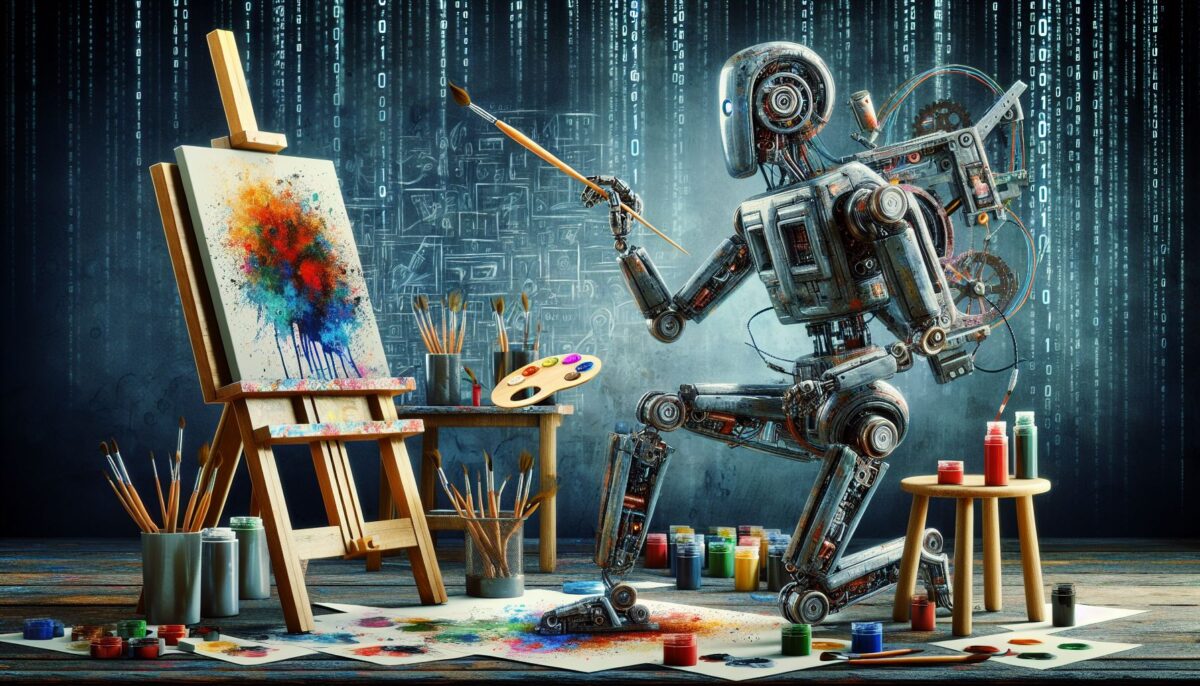
Hey fellow tech enthusiasts! Grab your favorite caffeinated beverage and settle in, because today, we’re diving into a topic that never fails to blur the lines between human potential and technological ingenuity: Artificial Intelligence in the creative arts. That’s right—machines aren’t just learning to think (if we can call it that) but they’re also learning to feel, in a manner of speaking. Imagine an AI that doesn’t just calculate but paints, crafts music, and even writes poetry. Is this the future of art? Could very well be. Let’s explore!
Machines With Imagination: Sounds Crazy, Right?
First, let me share a little personal tidbit. When I was a kid, I was fascinated by those “create your own adventure” storybooks—remember those? Fast forward to my adult life, and watching AI create stories, images, and music feels like I’ve been handed one big cosmic adventure book where each turn of the page is coded in binary stars. For me, it’s like seeing a long-lost dream come alive. But let’s not get too romantic. AI in the creative realm has serious implications and challenges that need hashing out.
Recent Milestones: Making Waves in the Art World
So what’s happened recently to make everyone lose their minds? For starters, AI-generated artworks have started showing up in mainstream art spaces and galleries. Take Christie’s 2018 auction of an AI-generated portrait called “Edmond de Belamy,” which sold for a jaw-dropping $432,500. That’s some serious cash for something created by an algorithm!
OpenAI’s DALL-E continues to blow minds with what it can do. Using massive datasets, DALL-E can generate images from textual descriptions. “An astronaut riding a horse in a futuristic cityscape” or “A Victorian-style portrait of a koala in a top hat”—done!
Music to Our Ears: The Sonic Frontier
The visual arts aren’t the only ones getting attention. AI is also making noise in music composition. Tools like Amper Music and AIVA use deep learning to analyze music theory and historical compositions, then come up with brand-new tunes. Fun fact: AIVA is even recognized by a musical organization—a world first—which means it can technically “compose” legally protected music. I mean, come on! How wild is that?
But let’s be real here. While AI can understand structure and theory, we’re nowhere near the masterpieces of Beethoven or The Beatles. Yet. Whether it’s cranking up heavy metal riffs or composing symphonies, getting AI to make emotionally resonant music is where the real challenge lives.
The Human Element: Are We Being Replaced?
Now, let’s tackle the elephant in the room: is AI about to kick us out of our own creative spaces? Not anytime soon, friend. While AI can mimic certain parts of creativity, it doesn’t mean we’re about to see software race past the Sistine Chapel or an AI author shooting to the top of the New York Times Best Sellers list.
Why? Because creativity is more than just mixing colors, notes, or words. It’s about emotion, experience, and sometimes, a sprinkle of madness—something that AI isn’t equipped to handle. Yet.
But here’s the thing: AI can actually boost human creativity. Imagine artists using AI to break traditional boundaries, generating ideas they couldn’t dream up on their own. It could completely change what “collaboration” means in art!
Breaking the Mold: A New Genre Emerges
Case in point: Bahrain-based artist Faiq Alfaker went viral after creating his own visual style using an AI training model of his previous works. It wasn’t just human and machine working together, but a completely new genre that developed naturally. Kind of like the jazz of the tech world.
Challenges and Ethical Quandaries
Of course, it’s not all sunshine and rainbows. AI-generated art brings its own messy set of ethical and legal questions. Who owns a piece created by AI? Who’s responsible if the generated content has unintended bias or copyright problems?
These challenges need real answers if AI art is going to work long-term in our creative world. Some interesting laws and guidelines are being discussed, but we’re still figuring this out as we go, and there’s a chance to get it right.
What Does the Crystal Ball Say?
Looking into tech’s future can be like staring at a surrealist painting—confusing yet fascinating. There’s a lot of room for guessing here. We might see a future where AI helps human artists, pushing them toward creative territories they couldn’t explore alone.
Or we could see the rise of a genre that’s purely AI-crafted, appreciated for what it is—a strange but compelling conversation between cold computation and abstract emotion.
Final Thoughts: The Coming Renaissance?
So there you have it—the full story on the wonders, challenges, and future of AI in creative arts. Whether this turns out to be a renaissance or something completely different, one thing’s certain: the relationship between humans and machines is changing, and we get front-row seats to watch it happen.
Are you ready for it? What potential collaborations excite or scare you? Drop your thoughts in the comments because this conversation, with all its messiness and complexity, is nowhere near finished.
For now, though, enjoy the ride. As they say, the world is your (digital) canvas!
