The Promise We’ve Been Waiting For
Remember that moment when you finally understood something that had been frustrating you for weeks? That’s the feeling Khan Academy has been chasing since its inception, and with Khanmigo, their AI tutor powered by GPT-4 and later upgraded to GPT-4o in 2024, they’ve gotten remarkably close to scaling that one-on-one teacher moment to millions of students. By the end of 2025, Khanmigo had reached over 5 million students across 110 countries, which tells us something important: the infrastructure is there, the technology is working, and the access questions are shifting from “if” to “how well” and “for whom?”
But here’s what we need to sit with as educators and learners: access and effectiveness are not the same thing. I’ve seen plenty of shiny educational tools come and go, promised as the solution to struggling students and overworked teachers, only to collect digital dust in a folder labeled “unused pilot programs.” So the real question isn’t whether Khanmigo exists or reaches people. The question is whether it actually changes learning outcomes for students who need the most support.
What the Learning Science Actually Shows
Let me walk you through the research, because this is where things get interesting and where I think Khanmigo genuinely has something to teach us. A randomized controlled trial published in Educational Technology Research and Development in mid-2025 found that students using Khanmigo for math support three times per week demonstrated a 0.34 standard deviation improvement in algebra scores over one semester compared to a control group. Now, if you’re not a statistician, let me translate that into classroom language: that’s a meaningful gain, the kind that shows up when you look at actual student transcripts and class placements.
What makes this result particularly compelling is the consistency of the intervention. Three times per week matters. This isn’t a case where students used the tool sporadically and saw miraculous gains. The students who benefited were those who engaged with the system regularly, with intention, and with what we call “spacing” in learning science. Their brains had time between sessions to consolidate what they learned. They returned to problem types they’d struggled with before, which is when deep learning actually happens.
The most-used feature tells us something revealing, too. According to Sal Khan in a January 2026 EdSurge interview, Khanmigo’s tutor mode had logged over 300 million student interactions, with step-by-step math problem deconstruction being the overwhelmingly preferred feature. Students aren’t asking the AI to do the problem for them. They’re asking it to help them understand the steps, to slow down the thinking process, to see where they went wrong. That’s the pedagogically sound use case right there, and it’s the one students are choosing.
The Access Question We Still Need to Solve
Here’s where my optimism meets reality, and I want to be honest with you about this. In 2025, Khan Academy made Khanmigo free to all U.S. teachers, subsidized by a $10 million grant from the Gates Foundation announced in late 2024. That’s genuinely significant policy work. Teachers could introduce Khanmigo to students without worrying about cost barriers, without asking families to purchase subscriptions, without creating a two-tiered system where some students get AI tutoring and others don’t.
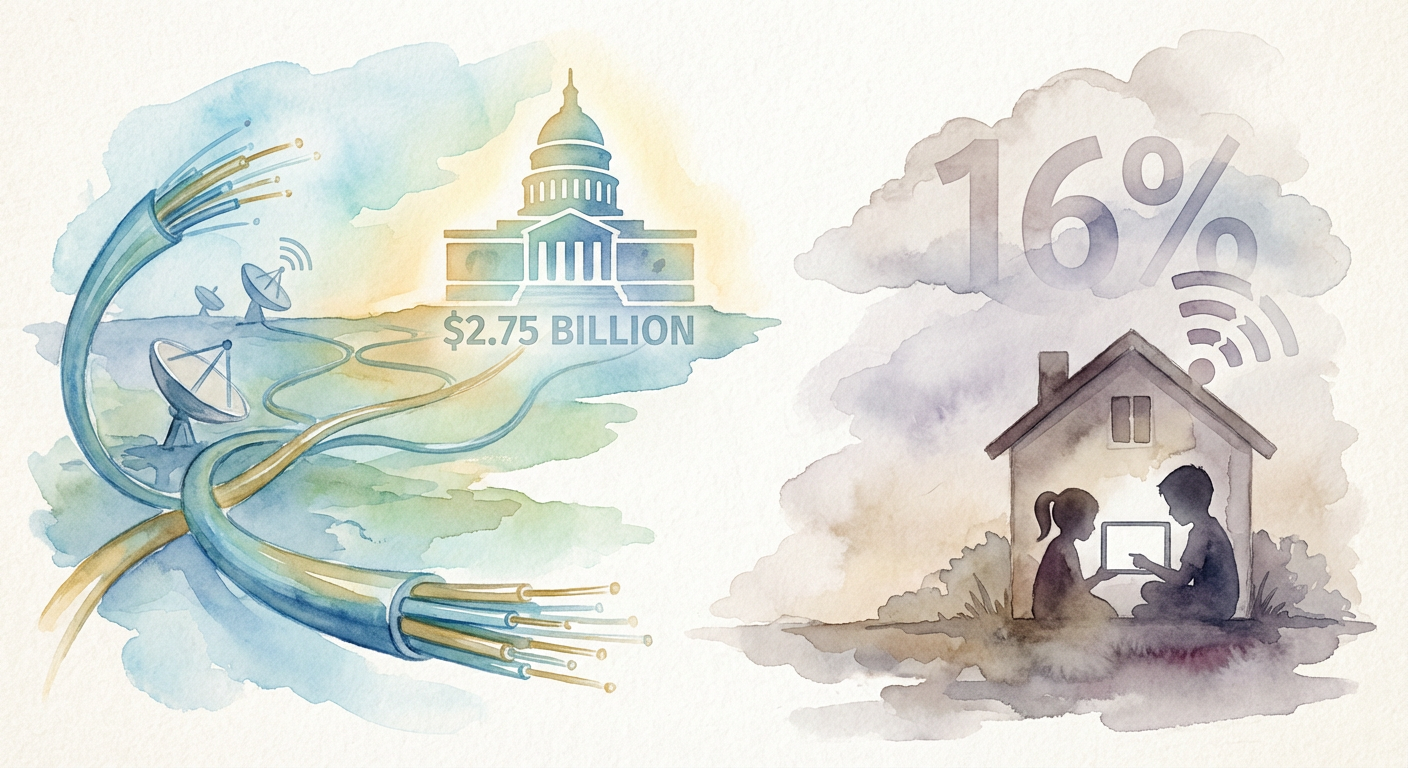
But access to the software is only half the equation. The other half is access to the internet, and we haven’t solved that. A 2025 Pew Research Center report found that 16 percent of U.S. households with school-age children still lacked reliable home internet. Consider what that means: those students can’t use Khanmigo at home during homework time, which is when they need it most. They might access it at school if their school has the infrastructure and scheduled computer lab time, but that’s sporadic and structured, not responsive to when confusion strikes at 7 p.m. on a Tuesday. Pew Research Center Digital Divide Data on this issue has remained stubbornly consistent across years: the digital divide still correlates strongly with socioeconomic status and rural geography.
The 2024 federal budget included provisions from the Digital Equity Act that allocated $2.75 billion for broadband expansion. That’s real money aimed at a real problem. But implementation takes time. Infrastructure doesn’t materialize in a year or two. So we’re in this in-between moment where the pedagogical tool is ready, but the foundational access infrastructure is still being built out.
What Teachers Are Actually Using It For
I want to shift here to what I’ve observed from colleagues and what I’ve read from teacher accounts of Khanmigo in practice. It’s not replacing teachers. Let me be clear about that, because there’s always this undercurrent of fear in education that AI will do that. Instead, teachers are using Khan Academy Khanmigo for Teachers to handle the individual support piece while they handle the relational piece, the motivation piece, the “I notice you’re struggling with quadratic equations and I want to check in about what that feels like” piece.
What’s happening in effective implementations is something like this: a student gets stuck on homework. Instead of waiting for office hours or turning in incomplete work, they interact with Khanmigo, which walks them through the problem deconstruction. The AI asks guiding questions. It doesn’t just give answers. The student has a moment of understanding at 9 p.m., and that matters psychologically. They feel less stuck. The next morning, they come to class with questions about the problem they actually completed, which means class time can be spent on harder conceptual work rather than reteaching the basics.
Looking Forward: Promise with Caveats
So has AI tutoring delivered on its promise? The honest answer is yes, with important asterisks. For students with reliable access to the technology and consistent engagement, there’s evidence that Khanmigo improves math learning outcomes in meaningful ways. The learning science is sound, the implementation research is promising, and the scale is real. Five million students using a tool that actually shows evidence of working is not nothing.
But promise and equity aren’t automatically the same thing. Khanmigo works best for students who have time, internet access, and some baseline academic confidence to engage with a technology rather than dismiss it. For students experiencing housing instability, living in rural areas without broadband, or carrying the weight of not having seen adults model academic engagement, the promise is more fragile. The tool exists. The grant funding exists. But the structural conditions that would make this a genuine game-changer for underserved students are still catching up.
I think of this moment in education technology the way I think of a student who’s finally grasping a difficult concept: we’re getting there, but we’re not done yet. The question isn’t whether Khanmigo works. The question is whether we’re willing to do the slower, less flashy work of making sure the internet is actually in the homes where students need it, that teachers have time built into their schedules to learn tools like this, that students have a reason to trust this new form of support.
What’s your experience been with AI tutoring tools in your classroom or learning? I’m genuinely curious whether what you’re seeing matches what the research shows, and where you think the biggest barriers still are.
