
When Sarah Finally Got Fractions (And How I Knew She Really Got Them)
Picture this: Sarah sits at her desk, confidently explaining to her partner why three-fourths is bigger than five-eighths using pizza slices she drew herself. Two months earlier, this same student had tears in her eyes during our fractions unit, convinced she was “bad at math.” What changed wasn’t Sarah’s mathematical ability—it was how I assessed her understanding.
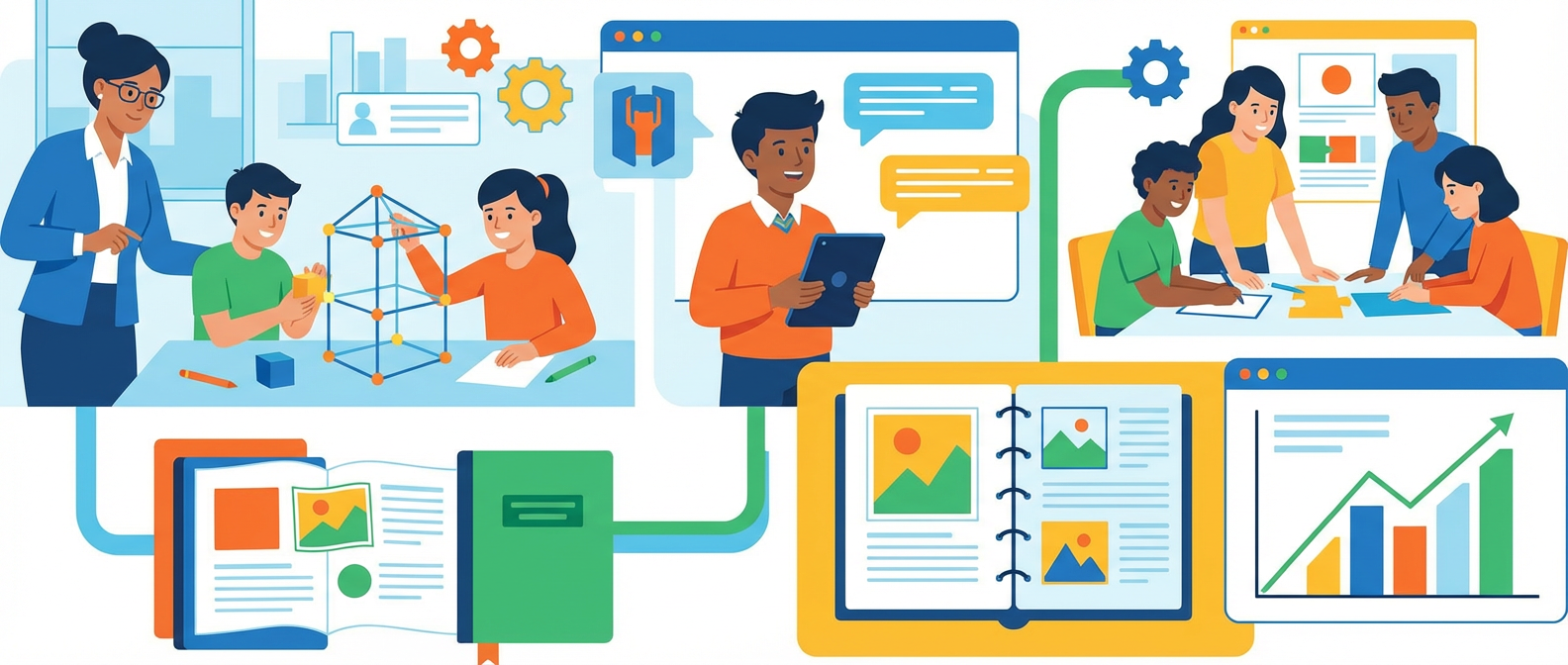
Instead of another worksheet with twenty problems asking her to circle the larger fraction, I watched Sarah teach someone else. I listened as she used her own words to explain why the pieces mattered more than the numbers. I saw her draw pictures that made sense to her brain. That’s when I knew—really knew—that she understood fractions at a deep level.
This moment made me realize something I’d been wrestling with for years. Traditional assessments often hide what students actually understand while highlighting what they struggle to show us. Sarah could think mathematically, but she couldn’t perform mathematically under the pressure of a timed test. Once I learned to separate these two things, everything changed.

The Three-Mirror Approach: Seeing Understanding From Every Angle
Think of assessment like using multiple mirrors to see your whole reflection. One mirror might catch the light differently, or show an angle that’s not quite right. But three mirrors positioned thoughtfully? Now you get the complete picture.
The first mirror is the “thinking mirror”—conversations, explanations, and student-led demonstrations. When Marcus explains why his science experiment didn’t work as expected, describing his hypothesis and walking through each variable, he’s showing me his scientific thinking process. I’m not grading his conclusion. I’m assessing how he reasons through problems.
The second mirror reflects application—students using their knowledge in new situations. Instead of asking students to define photosynthesis, I might show them a wilting plant and ask them to diagnose the problem using what they know about how plants make food. Suddenly, textbook knowledge becomes detective work.
The third mirror captures growth over time through portfolios, learning journals, or revision processes. When Emma looks back at her September writing sample and explains what she notices about her growth, she’s demonstrating metacognition—thinking about thinking. This tells me far more about her development than any single assignment could.
Exit Tickets That Actually Tell You Something
Let me share what transformed my daily assessment routine: exit tickets that go beyond “What did you learn today?” These tiny windows into student thinking became my secret weapon for understanding who was ready to move forward and who needed more time.
Try this tomorrow. Instead of asking students to summarize the lesson, give them a problem that requires today’s concept but looks different from your examples. After a lesson on equivalent fractions, don’t ask them to find equivalent fractions. Show them a recipe that feeds four people and ask how they’d modify it to feed six people. Students who truly understand equivalent fractions will see the connection immediately.
Or take the “teach your grandmother” approach. Ask students to explain today’s concept as if they’re talking to someone who’s never heard of it before. When Jennifer explains slope by comparing it to the steepness of her driveway versus the ramp at the skate park, I know she’s internalized the concept beyond memorizing rise over run.
The magic happens when you read these responses not as right or wrong, but as maps of student thinking. Patterns emerge. Misconceptions become visible. You start planning tomorrow’s lesson based on what students actually need, not what the textbook says comes next.
Performance Tasks That Feel Like Real Life
Remember when you learned to drive? Your driving test wasn’t multiple choice questions about turn signals. You got behind the wheel and drove. That’s the power of performance assessment—students demonstrate their learning by doing something real with their knowledge.
In my classroom, students don’t just study persuasive writing techniques. They research a local issue they care about and present their findings to our city council member during his monthly school visit. They don’t just learn about ecosystems. They design a plan to improve biodiversity in our school courtyard and pitch it to the principal. These aren’t cute activities. They’re rigorous assessments that reveal depth of understanding in ways traditional tests simply cannot.
The key is scaffolding these experiences so every student can succeed while still challenging everyone to think deeply. Start with clear criteria: What does strong research look like? How do we know when evidence supports a claim? What makes a presentation compelling? Then teach those skills explicitly before expecting students to demonstrate them.
Watch what happens when assessment feels purposeful. Students invest differently when they know their work matters beyond the gradebook. They ask better questions, seek feedback more actively, and develop the kind of motivation that sustains lifelong learning.
Making It Manageable (Because You’re Already Exhausted)
I know what you’re thinking: “This sounds amazing, but I have 150 students and three different preps. How is this possible?” Fair question. The secret isn’t doing more assessment—it’s doing smarter assessment.
Start small with one class or one unit. Replace that Friday quiz with student-created concept maps where they show relationships between this week’s ideas. Instead of grading thirty individual projects, have students present to each other while you rotate with a simple rubric, listening for evidence of understanding. Use voice memos for quick feedback instead of written comments that take forever to compose.
Collaborate strategically. Partner with a colleague to create a bank of performance tasks you can both use. Invite students to self-assess and peer-assess using clear criteria before you ever look at their work. This isn’t just efficient—it develops their ability to recognize quality work, which research shows improves their own performance.
Remember that not every assignment needs intense assessment. Sometimes a quick thumbs up or down tells you what you need to know. Save your deep assessment energy for the moments that matter most—when students are grappling with essential concepts or demonstrating growth over time.
The beautiful truth about effective assessment is that it makes teaching more joyful, not more burdensome. When you really see what students understand, you can celebrate their thinking, address their confusion with precision, and design learning experiences that meet them exactly where they are. What could be more energizing than that?
