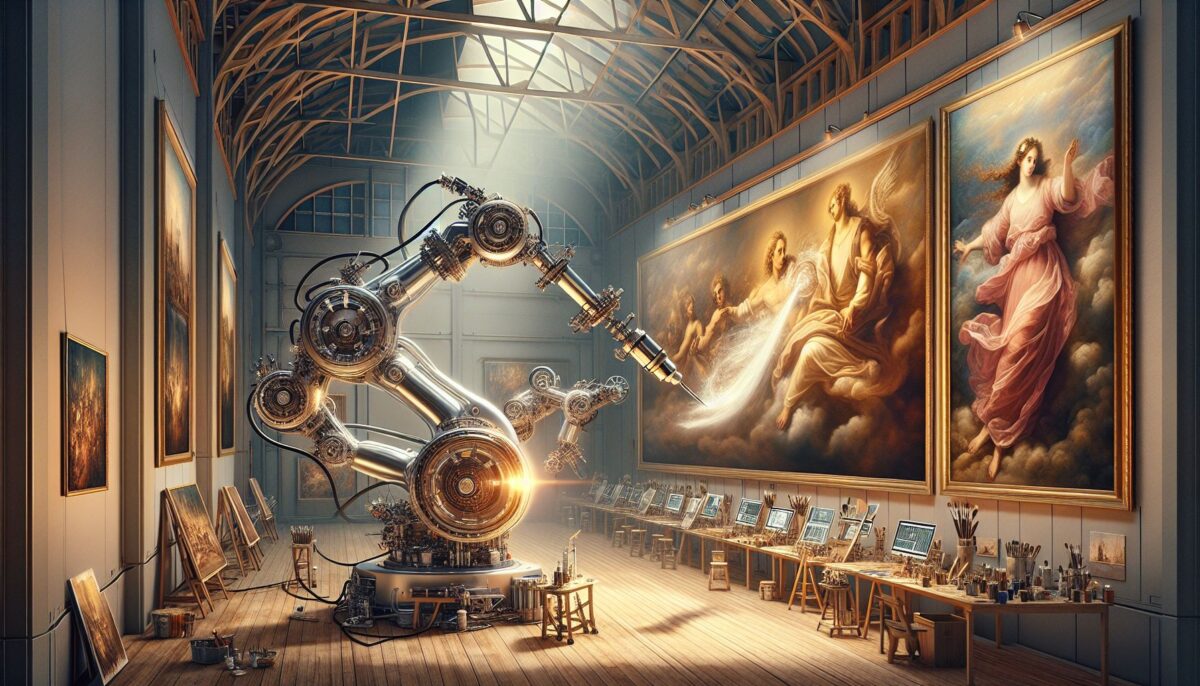
Hey, tech enthusiasts! Grab your favorite caffeinated beverage and settle in because today, we’re diving into the wonderfully wild world of AI in creative arts. It’s like discovering a whole new color in the rainbow — unexpected and honestly pretty mind-blowing. As someone who’s watched AI evolve from the early, clumsy beginnings to the current explosion of creative prowess, I’m pumped to share some insights into how this technology is changing art as we know it. So, let’s roll up our sleeves and let our pixels run wild!
The Birth of AI Artistry
Once upon a time in the not-so-distant past, artificial intelligence was primarily the domain of number-crunching and predictions. You know the drill — stock markets, weather forecasts, maybe even your smart thermostat deciding it’s too cool for comfort at 2 AM. But then, like a plot twist in your favorite sci-fi novel, AI decided it wanted to try something different: get creative.
The breakthrough moment? Generative Adversarial Networks (GANs). These nifty algorithms operate on a game of cat and mouse, where two networks battle it out — one trying to create something (the generator) and the other trying to determine if it’s real or fake (the discriminator). Sounds like Hollywood material already, doesn’t it?
These networks have created AI-generated art that can make you do a double-take, questioning if an esteemed artist crafted it or a computer algorithm. From dreamy landscapes reminiscent of Monet to portraits that eerily echo the brushstrokes of Van Gogh, AI has proven it’s got a knack for mimicry and much more.
AI: The New Artist in the House
Okay, so AI’s mimicry skills are top-notch, but what does this mean for actual artists? Will their creative juices dry up, leaving a world of algorithm-generated monotony? Not so fast, my friend.
Rather than replacing artists, AI is becoming a formidable collaborator. Imagine this: you’re an aspiring author staring at a blank screen, that cursor becoming more mocking with every blink. Enter AI — not to write your novel, but to brainstorm with you, offering plot twists or character arcs you hadn’t considered.
In visual arts, programs like DeepArt and Runway ML have allowed artists to explore new styles with ease, generating drafts or ideas that can be fine-tuned by the human hand. It’s kind of like having an intern who tirelessly drafts concepts but leaves the final touches to you, the maestro. The creativity remains uniquely human, with AI working as an exciting tool that pushes the boundaries of what’s possible.
Challenges and Ethical Dilemmas
As rosy as this future sounds, it wouldn’t be a true innovation without its share of challenges. For starters, there’s the ownership conundrum: if an AI creates a masterpiece, who gets the bragging rights? The programmer? The algorithm itself? Does the AI deserve its own exhibition, complete with a press tour and a misunderstood-but-quirky persona?
Then there’s the human element — or lack thereof. One can argue that art without human emotion lacks depth, that the absence of experience and suffering (or joy) creates a void that no algorithm can fill. With AI-generated art, are we just grazing the surface of creativity without the rich subtext?
Ethics aside, there’s also the hurdle of accessibility. While big companies like OpenAI and Adobe push the envelope, the technology isn’t universally available just yet. The digital divide can still keep many budding artists from leveraging these tools, leaving a gap that needs bridging.
The Future Canvas: AI and Artistic Evolution
Fast-forward a decade, and we might see AI as an integral part of our artistic journeys, just like the trusted paintbrush or piano keys. One exciting prospect is the potential for personalized art — pieces tailor-made by AI to suit your tastes, your moods, your quirks. It might recommend the perfect artwork for your living room, created specifically with your ambiance in mind.
AI could also democratize art further, making it more accessible and allowing anyone with an idea to manifest it beautifully, regardless of their physical abilities or resources. Imagine an explosion of creativity where everyone gets their moment to shine, aided by an AI that knows just how to bring their vision to life.
Final Thoughts
To say we’re on the cusp of an artistic revolution might sound dramatic, yet also undeniably true. As AI continues to dazzle us with its creative capabilities, we stand to witness a renaissance unlike any before. Who knew silicon and syntax could wield a paintbrush or pen as deftly as an artist?
Let’s continue to contemplate, challenge, and ultimately embrace this new frontier. As technology evolves, so too will our definition of art, expanding like the universe itself. Keep those creative juices flowing, and remember: innovation, no matter how tech-driven, always starts with a spark of human curiosity. More on this next time, as we watch our palettes and prose grow richer with the power of AI.
Can we get applause — digital or otherwise — for our ethereal co-creators? Until next time, stay curious, stay creative!
