Educational content designed to spark curiosity and build real understanding.

Category: Main (page 7 of 11)

Why Smartphone Bans Are Sweeping Through U.S. Schools—And What the Research Actually Shows

The Quiet Revolution Happening in Your Kid’s School Right Now

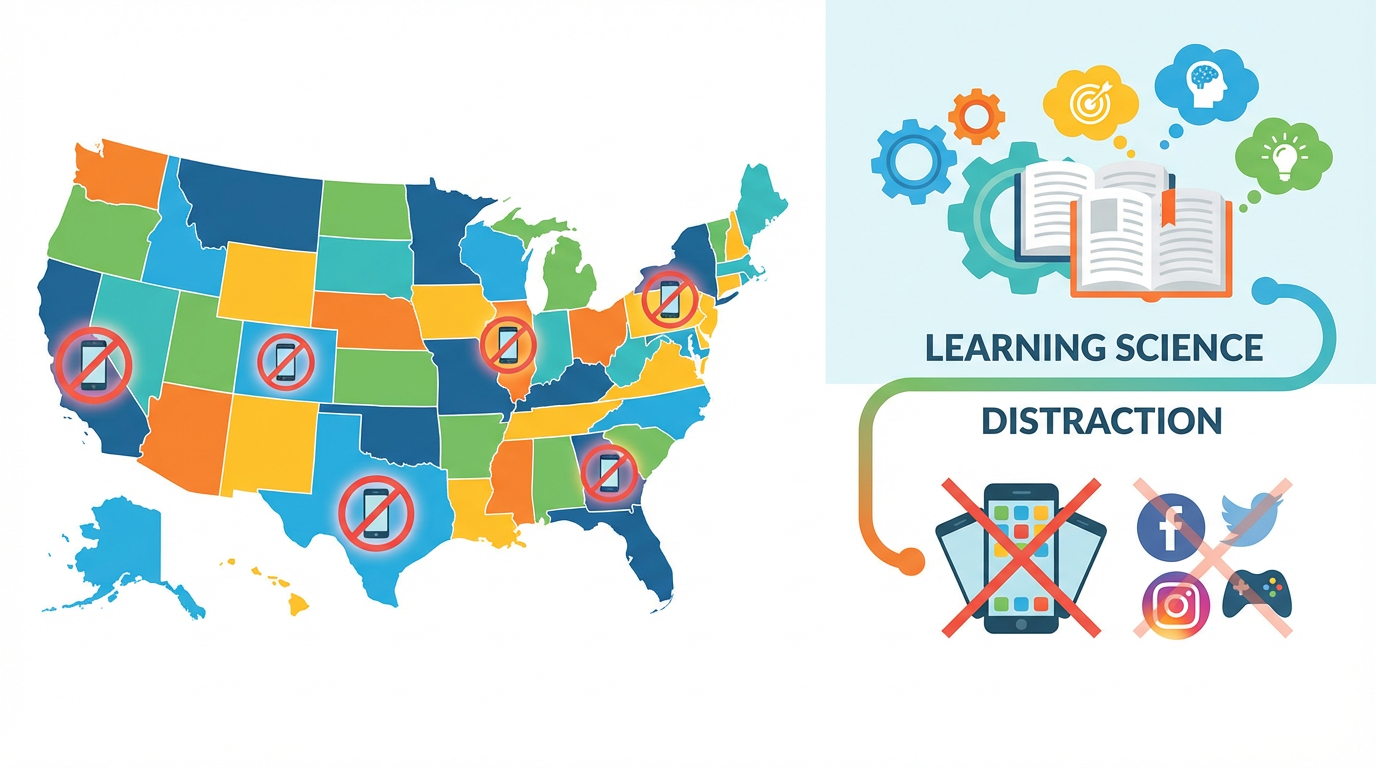
Something unexpected happened in American schools between 2024 and early 2026. Nineteen states passed or implemented laws restricting smartphone use during the school day. That’s more than double the number from just two years earlier. Think about that for a moment. Nineteen states. Legislatures actually moving on this. Not suggesting it. Not recommending it. Legally restricting it.

Why Smartphone Bans Are Sweeping Through U.S. Schools—And What the Research Actually Shows

When I first started teaching fifteen years ago, smartphones barely existed in student hands. Now they’re everywhere—in backpacks, sometimes in pockets, definitely in the collective consciousness of every kid in a classroom. What’s striking isn’t that schools are cracking down. It’s that the crackdown is accelerating, and it’s not driven by nostalgia or “kids these days” hand-wringing. It’s driven by numbers. Data. The kind of evidence that makes even skeptical administrators sit up and listen.

So let’s talk about what’s actually happening, what the learning science tells us, and what this means if you’re a parent, a teacher, or someone who genuinely cares about how young people learn.

Here’s What the Numbers Are Telling Us

Let me start with something concrete you can picture. Right now, the average American teenager spends five hours and fourteen minutes on their phone every single day. That’s not hyperbole. That’s from the Common Sense Media 2025 Technology Use Census. Now here’s the part that matters for schools: forty-three percent of that daily screen time happens between 8am and 3pm, the exact hours kids are supposed to be learning.

That’s roughly two hours and fifteen minutes every school day. During school. While teachers are trying to explain quadratic equations or the causes of the Civil War or how cells divide.

The picture gets clearer when you look at what happens when you actually remove that variable from the equation. A 2025 study published in Educational Psychology, a peer-reviewed journal, found something striking. Students in smartphone-free classrooms scored fourteen percent higher on end-of-unit assessments. They also reported twenty-two percent lower anxiety levels. A fourteen percent improvement is the kind of number that makes you reconsider what’s actually happening in your classroom.

International data gives us even more to think about. When the UK implemented a full national smartphone ban in secondary schools in 2024, their Department for Education conducted a first-year review. Test participation rates improved by 1.8 percent. That sounds modest until you remember we’re talking about millions of students across an entire nation.

Why This Matters for How Your Brain Actually Works

Here’s what happens in a classroom when a phone is present, even if it’s not in your hand. Your brain doesn’t work in neat compartments. You can’t just ignore something and then flip attention back on like a light switch. What actually happens is something neuroscientists call “cognitive load.” Your working memory, the mental space where actual learning happens, gets divided.

Imagine you’re trying to solve a complex math problem. Your teacher is explaining the steps. You’re following along. But there’s a phone sitting on the desk, not buzzing, not even lit up, just present. Part of your attention is still allocated to that device. You’re not conscious of it, but it’s there, dividing your cognitive resources. Now add the fact that most students aren’t just sitting near their phones passively. They’re actively using them. That cognitive load isn’t divided. It’s shattered.

The learning scientists at the Anxious Generation initiative, working with researchers like Jonathan Haidt, released a policy brief in late 2025 that reviewed eleven peer-reviewed studies. The finding was consistent across all of them: device-free zones work as a protective factor against adolescent depression. Not a cure. A protective factor. Something that reduces risk. Read Jonathan Haidt’s After Babel Substack — School Smartphone Policy if you want to dig into the neurological mechanisms. The short version: when kids aren’t anxiously checking their devices during the school day, their anxiety decreases.

That’s not because phones are evil. It’s because notifications are designed to be compelling. Apps are engineered to create habits. And adolescent brains are particularly vulnerable to that design because the reward centers develop faster than the impulse control centers. Your average eighth grader isn’t weak-willed. They’re neurologically set up to find phones more compelling than their algebra homework.

What This Means If You’re Actually Teaching or Parenting

I want to be honest about something here. Banning smartphones in schools works, but only if it’s actually enforced and the culture around it shifts. You can’t just collect phones at the door and then have teachers constantly battling over compliance. That defeats the purpose. The point isn’t punishment. The point is creating an environment where learning can happen without constant competing stimulation.

If your child’s school is implementing or considering a smartphone restriction, the research suggests a few things. Consistency matters more than severity. Clear rules that everyone follows are more effective than ambiguous policies enforced inconsistently. The benefits also compound over time. You don’t see the fourteen percent improvement in test scores overnight. It builds as kids’ brains adjust to having space to think deeply. The anxiety reduction tends to come faster, though. Students report lower stress within weeks when they’re not carrying the psychological weight of checking their phones.

What doesn’t work is banning phones from schools while simultaneously expecting kids to use them responsibly at home. That’s asking for something neurologically unrealistic. This is where parental involvement matters. If your school is creating phone-free learning time, that’s the moment to think about what’s happening in your home. Not as punishment, but as reinforcement. As creating a consistent space where deep focus is possible.

The Bigger Picture: Why This Is Happening Now

The nineteen states passing these laws in 2024 and 2025 weren’t doing it because of one study or one politician’s pet project. They were responding to accumulating evidence. Teachers reporting classroom management challenges. Students reporting anxiety. Parents asking questions. Researchers publishing consistent findings. When you get alignment like that, policy follows.

What’s fascinating is how rapidly the conversation has shifted. Three years ago, suggesting schools ban smartphones would have generated fierce pushback about digital natives and technological inevitability. Now it’s becoming standard policy in nearly a fifth of American states. That shift didn’t happen because older people suddenly got more conservative. It happened because the data became undeniable.

If you’re a parent trying to navigate this, a teacher wondering whether to advocate for policy changes, or a student trying to understand why your school is making these changes, the answer is pretty straightforward: learning actually works better when your brain isn’t split between two tasks. Your focus improves. Your anxiety decreases. Your test scores go up. That’s not opinion. That’s what the research shows.

What’s your experience been? If your school has implemented smartphone restrictions, what changes have you actually noticed? Or if you’re thinking about advocating for policy changes, what concerns are holding you back? I’d genuinely love to hear where you’re coming from on this, not because I have all the answers, but because figuring out how to help kids learn well is something we’re all working through together.

What Khan Academy’s Khanmigo 2.0 Actually Gets Right (And Wrong) About AI Tutoring in 2026

The Promise We Thought We Had

When Khan Academy launched Khanmigo back in 2023, the education world held its breath. Here, finally, was an AI tutor that could theoretically give every student their own personal guide—someone patient, infinitely available, and armed with pedagogical precision. The numbers initially looked good. By late 2025, the platform had logged over 50 million tutoring sessions, and middle school math completion rates jumped 23 percent among users. For Title I schools especially, where budget constraints make hiring additional tutors impossible, the Gates Foundation’s Q3 2025 commitment of $15 million to expand Khanmigo across 12 states felt like a genuine breakthrough. This wasn’t just another edtech promise. This felt real.

But here’s what I’ve learned after two decades in classrooms: promising numbers and actual learning are not always the same thing. They’re not even close sometimes. So I spent the last few months genuinely interrogating what Khanmigo 2.0 does well and where it stumbles in ways that matter for how your brain actually learns.

Where Khanmigo Actually Nails It: The Socratic Approach

The part that made me sit up and take notice involves how Khanmigo 2.0 handles questioning. Recent research from Stanford PACE Center AI in Education Reports found something remarkably clear: AI tutors that ask Socratic questions instead of offering direct answers perform 31 percent better on retention tests two weeks later. Thirty-one percent. That’s the difference between a student genuinely understanding photosynthesis and a student who memorized the steps for a quiz.

Khanmigo 2.0 has internalized this. When a student struggles with, say, setting up a multi-step algebra problem, the system doesn’t just say “multiply both sides by three.” It asks: What do you notice about the equation? What would happen if you moved all the variables to one side? What operation undoes multiplication? This mirrors what actually happens in my classroom when I’m helping a student think through something rather than handing them the answer. The research backs this up completely, and watching Khanmigo handle this correctly feels like vindication that learning science finally made it into mainstream AI design.

The platform’s work with English language learners deserves special mention because it’s where the gains feel most meaningful. According to Khan Academy’s own 2025 efficacy report, ELL students showed a 41 percent improvement in reading comprehension scores after eight weeks of Khanmigo use. That’s not a rounding error. That matters profoundly for students whose learning barriers have nothing to do with ability and everything to do with access to patient, culturally responsive instruction.

The Dangerous Problem: Students Stop Struggling Productively

But here’s where I have to be honest about something that concerns me deeply. A January 2026 RAND Corporation survey found that 67 percent of teachers using AI tutoring tools reported that their students became less likely to struggle productively with difficult problems. Let me translate what that means in learning science terms: struggle is where learning actually lives. When you wrestle with a challenging concept, your brain forms stronger neural pathways than when someone explains it to you. Productive struggle—the kind that feels hard but achievable—is essential to real understanding.

The risk with an AI tutor that’s always available and always helpful is that it can short-circuit this process. A student gets stuck, the AI jumps in with a guiding question, the student finds the answer, and everyone feels good. But the student’s brain never learned to sit with confusion. They never developed the metacognitive skills that come from pushing through difficulty on their own first. This is subtle enough that it’s easy to miss, especially when completion rates are climbing and assessment scores are improving. But it’s the difference between a student who can solve a problem and a student who is becoming a problem-solver.

Think about it this way: if I let every student check with me the moment they felt uncertain, would my classroom improve or would it create learned helplessness? That tension doesn’t disappear just because the helper is artificial. It gets more complicated.

What Khanmigo 2.0 Gets Wrong: Relationship and Accountability

There’s something about the human relationship between a teacher and student that AI, no matter how sophisticated, cannot replicate. When I remember that you found fractions impossible in September but mastered them by April, I’m not just pulling up data points. I’m acknowledging your growth. I’m communicating that I see you. That I believed you could do this. I have accountability to you in a way that an algorithm doesn’t.

Khanmigo 2.0 is extraordinarily good at being consistent, patient, and evidence-based. But it has no stake in your success beyond the parameters of its design. It cannot call your parent because it notices you’re slipping. It cannot catch the moment when you’re overwhelmed versus when you’re just procrastinating. It cannot adjust its teaching style when it senses that you learn through humor or movement or talking things out loud. These aren’t flaws in Khanmigo specifically. They’re inherent limitations of the technology, and pretending otherwise would be dishonest.

The research showing gains in math completion rates and reading comprehension is genuinely impressive. But those metrics don’t capture everything that matters in learning. They don’t measure whether a student developed genuine curiosity about the subject. They don’t track whether a student learned to advocate for themselves. They don’t capture the quiet moment when a struggling student finally believed they could do hard things.

How to Use Khanmigo Wisely (Spoiler: It’s Supplement, Not Substitute)

Here’s what I actually recommend if you’re considering Khanmigo 2.0, whether you’re a teacher, parent, or student. Use it strategically as a supplement, not a replacement. It excels at providing immediate, responsive help with discrete skills and at giving students practice with Socratic questioning, which genuinely deepens retention. The platform is particularly strong for students who are shy about asking questions in class or who need explanations at 11 p.m. on a Sunday. For ELL students and others who benefit from multiple exposures to content, the research is clear that it works.

But preserve productive struggle. Maybe Khanmigo handles practice problems, but you or your teacher handles the initial problem-solving attempt without support. Maybe you use it to check your understanding after you’ve genuinely tried. Maybe you save it for reinforcement rather than first exposure. Build in moments where the answer is not available, where confusion is the actual goal.

Check out the detailed research yourself on Khan Academy Khanmigo Research and Efficacy so you understand what the data actually supports. The research is solid where it’s solid, and it’s worth engaging with on its own terms rather than taking anyone’s word for it—including mine.

What’s your experience been with AI tutoring tools? I’m genuinely curious whether these concerns ring true in your classroom or home school, or whether you’ve found ways to use these tools that navigate these tensions better than I’m imagining.

Can AI Really Replace Your Language Teacher? What the 2026 Data Actually Shows

The App That’s Taking Over Language Learning

By early 2026, something genuinely remarkable had happened in language education. Duolingo Max, the premium tier powered by advanced AI, had reached 9.5 million subscribers and was growing faster than any other paid product tier the company offered. The numbers tell a story: 116.7 million monthly active users across the entire platform, up 38% year-over-year. These aren’t vanity metrics. They represent real people choosing to spend money on AI-powered language learning, real people betting their time and attention on conversations with machines instead of humans.

I understand the appeal completely. An AI tutor available at 11 PM on a Tuesday. No judgment when you mispronounce a word for the fifth time. Immediate feedback. Infinite patience. As someone who has spent years watching students light up when they finally understand something, I also understand why school administrators are paying attention. When language teacher positions declined by 11% in U.S. K-12 schools between 2022 and 2025, district leaders began positioning apps like Duolingo as viable supplements, sometimes as replacements. The economic pressure is real. The promise of AI is real. But the question that keeps me up at night is whether the outcomes are actually real.

What the Research Actually Says About AI Conversation Partners

Here’s what surprised me when I dove into the 2025 research: the early findings are legitimately promising within specific boundaries. A study from City University of New York tracked adult learners using Duolingo Max’s Roleplay feature, which lets users have real-time conversations with an AI language partner. Thirty minutes of daily practice over twelve weeks brought learners to A2-level proficiency on the Common European Framework of Reference, the international standard for language ability. For context, A2 is “elementary proficiency.” You can handle basic survival situations. You can introduce yourself, ask directions, order food. That’s real progress, and it happened without a human teacher in the room.

The research available through the Duolingo Efficacy Research Library reveals something worth sitting with: the app works remarkably well for building foundational skills and maintaining consistency. The AI never cancels lessons. It adjusts difficulty. It provides immediate corrective feedback. For adult learners juggling work and family, who struggle with commitment and consistency, this matters a lot. You don’t need a teacher to move from zero to A2. You need structure, repetition, and accessible practice. The app delivers all three.

The Ceiling Nobody’s Talking About

But here’s where the picture gets complicated, and I want to be absolutely clear about this because it matters for your learning decisions. The American Council on the Teaching of Foreign Languages published an important position statement in 2025, and the headline is sobering: no app-based program had demonstrated B2-level conversational fluency without human instructor intervention. B2 is “upper intermediate” proficiency. You can participate in meetings. You can express opinions. You can handle complexity. This is the threshold where language becomes genuinely useful for work, travel, and real human connection.

When I say there’s a ceiling, I’m not being pessimistic. I’m reading the data. The research shows that something fundamental shifts around the intermediate level, and that’s when having another human in the conversation becomes irreplaceable. Why? Because human teachers do something AI still doesn’t do consistently: they push you past your comfortable patterns. They ask the unexpected question. They notice when you’re using the same ten phrases instead of expanding your range. They challenge you in ways that feel supportive rather than punitive.

The Hidden Trap: Fluency Illusion and Why It Matters

I need to tell you about something troubling that MIT Media Lab researchers discovered in January 2026. They studied how learners behaved with AI conversation partners and found something they called “fluency illusion.” When students practiced with AI, they gradually avoided grammatically complex sentence structures. Why? Because the AI never corrected them. Not out of incompetence, but because AI language partners tend to prioritize communication flow over grammatical precision. So learners felt fluent, felt successful, felt like they were improving. But they were actually simplifying their language rather than expanding it.

Think about this from a neuroscience perspective. Your brain learns through challenge and correction. When there are no consequences for grammatical shortcuts, when communication is always successful no matter what, your brain optimizes for efficiency rather than mastery. You feel like you’re making progress because the conversations flow smoothly. But you’re reinforcing patterns that wouldn’t work with native speakers. This is why that distinction between A2 and B2 matters so much. At A2, this doesn’t break your communication. At B2 and beyond, these gaps become obvious and frustrating.

The Real Question: Supplement or Replacement?

So can an app replace a language teacher? The honest answer is it depends on what you’re trying to achieve and where you are in your learning journey. If you’re starting from zero, if you need daily accessible practice and you live somewhere without access to quality teachers, Duolingo Max is genuinely better than nothing and probably better than sporadic in-person instruction. The research supports this. The consistency, the accessibility, the adaptive difficulty — these matter enormously for building foundational skills.

But if you want real fluency, if you want to genuinely use a language for complex communication, if you want to understand why something is wrong and how to fix it, an app alone probably won’t get you there. Not yet, anyway. What the data suggests is that the best approach combines both: AI for consistency, accessibility, and foundational building, with teachers handling challenge, complex feedback, cultural context, and that irreplaceable human element of being truly seen and understood as a learner.

I’d encourage you to look at ACTFL Position Statements on Language Learning Technology and form your own conclusions. Think hard about where you are in your language learning journey. What are you actually trying to achieve? What gaps exist in your current approach? I’d genuinely love to hear what you discover as you navigate these tools.

When Good Science Gets Messy Politics: Understanding the Reading Wars of 2026

The Movement That Changed Everything, Then Everything Changed Again

If you’ve been teaching reading in the last five years, you’ve felt the seismic shift. The science of reading movement arrived like a lighthouse cutting through fog—finally, we had research-backed evidence that explicit, systematic phonics instruction matters enormously for beginning readers. No more guessing games about what students needed. No more philosophical debates that seemed to ignore neuroscience. For many of us in the classroom, it felt like validation. It felt like progress.

But here’s what I want to walk you through today: why that lighthouse is now casting some very sharp shadows. The science itself hasn’t changed. What’s changed is what happens when research gets translated into policy, when enthusiasm becomes mandate, and when something genuinely good gets implemented in ways that create new problems while solving old ones.

Let me start with the concrete numbers, because they tell a story. In 2020, seventeen states had passed legislation requiring structured literacy and phonics-based approaches. By January 2026, that number had grown to forty states. You can track this shift in detail through the Education Commission of the States Literacy Policy Database, and what you’ll notice is the speed of adoption. That’s not gradual evolution. That’s a movement.

From Research to Reality: Where Translation Becomes Trouble

Let me give you a concrete example of how good intentions met complicated reality. California passed AB 2222 in 2024, requiring all kindergarten through third-grade teachers to complete science of reading training by 2026. That’s roughly 78,000 teachers across the state. Think about that number for a moment. Then think about coordinating professional development at that scale, with adequate funding, with quality facilitators, with time for teachers to actually process what they’re learning.

Here’s where the practical challenge becomes apparent: implementation matters as much as the research. A teacher who receives a one-day workshop on phonemic awareness is technically trained. But is she ready to assess where each of her 24 students sits on the phonological processing spectrum? Is he equipped with the right materials to teach phonics systematically to kids who speak Arabic at home and English at school? The research says phonics matters. It doesn’t say it’s simple, or that it works the same way for every learner.

The International Literacy Association surveyed their members in 2025, and here’s what reading specialists reported: sixty-one percent felt that state mandates were being rolled out without adequate teacher training or funding for instructional materials. In classrooms, that frustration looks like this: teachers being told to implement a specific approach but not given the time to learn it deeply or the tools to do it well. That’s not the science’s fault. That’s a policy implementation problem.

The Curriculum Question: How Much Is Too Much?

Here’s a case study that shows how even expert educators are wrestling with these questions. Lucy Calkins, whose Units of Study curriculum influenced writing instruction across the country, revised her entire curriculum in 2025 to incorporate explicit phonics instruction. That matters. That’s someone listening to research and saying, “I need to change what I’ve been doing.” I respect that intellectual humility.

But here’s where it gets complicated. A research team from Johns Hopkins examined the revised curriculum and found that explicit decoding instruction still only accounted for eighteen percent of instructional time in early grades. Is that enough? That’s the question creating tension right now. The science suggests that for struggling readers and students with dyslexia, decoding needs intensive, focused attention. But eighteen percent feels like a compromise position—more than before, sure, but is it what the research actually recommends?

This isn’t a criticism of Calkins or her team. It’s an illustration of a real problem: translating research into curriculum is genuinely hard. You can’t spend eighty percent of time on one component and ignore everything else. Fluency matters. Comprehension matters. Vocabulary matters. What’s the right balance? Different teachers, different students, and different communities might have legitimately different answers to that question.

The Voice That’s Being Lost: Pushback From Experienced Educators

In late 2025, a coalition of progressive educators published what they called the Oakland Declaration, the first organized, sophisticated pushback from inside the education community. Their argument deserves to be understood carefully, not dismissed. They contend that the science of reading movement, while built on solid research about phonics, draws from a research base that doesn’t adequately represent the full complexity of how people learn to read.

Their specific concern: the research base is narrow in its focus on decoding, and that narrowness has cultural consequences. Comprehension strategies—things like activating prior knowledge, asking questions while reading, making connections to students’ lives—aren’t replaced by phonics instruction, but they sometimes get pushed to the side when phonics becomes the policy priority. For multilingual learners especially, this shift matters. If a student knows oral English but is struggling to decode, the solution isn’t just more phonics. It might be oral language development. It might be culturally sustaining reading practices. It might be honoring the literacy practices students bring from home in other languages.

I want to be careful here: the Oakland Declaration isn’t saying phonics doesn’t matter. It’s saying that phonics isn’t the whole story, and that policy mandates sometimes flatten complex teaching into something too simple. When you tell 78,000 teachers across an entire state that they all need to teach reading the same way, you inevitably lose something: the responsive teaching that meets students where they actually are.

What This Means for Teachers Right Now

So where does this leave you if you’re in a classroom today? Honestly, in a position that matters more than it might feel like right now. The research on phonics is solid. You absolutely should understand how phonemic awareness develops. You should know how to teach phonetic patterns systematically. That’s not changing.

But you also need to advocate for something that rarely makes it into policy documents: professional judgment. You need permission to look at your individual students and say, “This approach works for most of them, but Marcus needs something different. Elena’s oral comprehension is strong, but her decoding is weak. Jayden speaks three languages at home.” That’s not defying the science. That’s applying the science with wisdom.

The backlash of 2026 isn’t a rejection of the science of reading. It’s a rejection of the idea that science should become a straightjacket. If you’re feeling caught between mandate and classroom reality, you’re not wrong. That tension is real. More voices are naming it publicly now, which at least means we’re having the right conversation.

What’s your experience been? If you’ve navigated these policy changes in your own teaching, what’s worked and what’s created friction? I’d genuinely like to hear where the rubber meets the road in your classroom, because that’s where the real story of reading instruction actually lives.

The 7 Non-Negotiable Skills Employers Want: A Learning Science Approach to Teaching Them Before Graduation

What Employers Actually Want (and Why Most Graduates Don’t Have It)

There’s a troubling gap between what graduates think they can do and what employers say they can actually do. The latest Coursera Global Skills Report 2026 draws on feedback from 148 million learners and nearly 6,000 employer partners worldwide, and the findings are clear: AI literacy, data storytelling, and human-AI collaboration top the list of skills employers say new graduates lack most urgently. These aren’t nice-to-have competencies anymore. They’re the foundation of what employers expect.

The perception gap is striking. A recent National Association of Colleges and Employers survey found that 78% of recent graduates rate themselves as proficient in data interpretation, yet only 41% of hiring managers agree. That 37-point gap tells us something important: students believe they understand data, but employers don’t see that understanding translate into actionable work. This isn’t about confidence. It’s about applied skill.

What makes this urgent is the velocity of change. The World Economic Forum Future of Jobs Report projects that 39% of existing skill sets will be disrupted or become obsolete by 2030. The skills we’re teaching today need to account for a landscape that keeps shifting under our feet.

The Seven Skills You Need to Teach Explicitly

Coursera’s research identifies seven skills employers are prioritizing: AI literacy, data storytelling, human-AI collaboration, analytical thinking, creative problem-solving, digital fluency, and learning agility. But here’s what matters from a learning science perspective: these skills aren’t acquired through passive exposure. They require deliberate practice, immediate feedback, and real-world application.

The encouraging news is that demand is driving enrollment. AI-adjacent course enrollments on Coursera grew 172% year-over-year in 2025, with the most significant growth among community college students and learners in sub-Saharan Africa. Learners recognize the urgency, and educators are finding ways to meet them. The question is whether we’re teaching these skills in ways that actually stick.

Analytical and creative thinking rank as the top two skills employers intend to develop, according to WEF data. This suggests that employers see these as learnable capacities, not innate talents. They’re willing to invest in teaching them, which means schools should prioritize them before graduation. When employers have to remediate fundamental thinking skills after hire, that’s a signal something is missing from your curriculum.

Project-Based Learning with Real AI Tools Works

Here’s where learning science meets practice. A 2025 pilot program involving 12 community college districts partnering with IBM SkillsBuild tested project-based learning that explicitly incorporated AI tool usage into coursework. The results: a 29% improvement in employer-rated job readiness scores at graduation compared to traditional instruction. That’s not a marginal improvement. That’s the difference between students who can theoretically explain what AI does and students who can actually use it to solve real problems.

Why does project-based learning with AI tools work? Because it creates what learning scientists call “transfer,” the ability to apply knowledge to new situations. When students work on authentic projects that require them to use AI as a tool rather than learning about AI in the abstract, they’re building mental models they can apply on day one of employment. They’re not just learning AI literacy. They’re learning how to think with AI, how to collaborate with AI, and how to maintain critical judgment while leveraging its capabilities.

The key is making these projects genuinely complex. A project that asks students to clean a dataset and visualize it is fine. A project that asks them to clean a dataset, visualize it, identify patterns, collaborate with an AI tool to generate hypotheses, then write a narrative for stakeholders, that’s the kind of work that develops actual job readiness. That’s data storytelling in action.

How to Build These Seven Skills Into Your Teaching

Start with analytical thinking and creative thinking because they undergird everything else. These aren’t separate from content knowledge; they’re ways of thinking about content. When you teach history, ask students not just what happened but why decision-makers at the time might have thought differently with different data. When you teach biology, ask students to design experiments to answer their own questions rather than replicate prescribed procedures. When you teach literature, ask students to solve interpretive problems, not just identify themes. This develops the cognitive flexibility employers are desperate for.

Next, integrate AI literacy and human-AI collaboration into your actual assignments. Don’t create a separate unit on AI. Instead, have students use AI tools to support their work in your existing courses. Let them experiment with what AI can do well and what it cannot. Have them collaborate with AI to accomplish something neither could accomplish alone. This develops intuition about capability and limitation that no lecture can provide.

Data storytelling requires three interlocking skills: data interpretation (understanding what data means), visualization (showing it clearly), and narrative construction (telling the human story the data reveals). You can teach this across disciplines. In science courses, have students interpret research findings and explain them to non-scientists. In history courses, have students work with datasets about demographic or economic trends and build arguments from that evidence. In business or social science courses, have students present data findings to simulated stakeholders. The skill transfers because the underlying cognitive processes are the same.

Digital fluency and learning agility are best developed through problem-solving in environments where tools change. Give students problems that require them to learn new tools or platforms independently. Normalize not knowing, and provide scaffolding for self-directed learning. When something breaks or changes, that’s not a disruption to plan around. That’s the actual curriculum teaching itself.

The Perception Gap Is Your Responsibility

That 37-point gap between student self-assessment and employer assessment of data proficiency exists partly because students have practiced demonstrating knowledge in familiar, controlled environments. They can answer test questions about data interpretation because the test format is predictable. But when they encounter messy, real-world data in an interview scenario or on a job, they freeze because they haven’t practiced applying their knowledge to genuinely novel situations.

Closing this gap means designing assessment that mirrors real-world uncertainty. Don’t ask students to analyze clean datasets with clear instructions. Ask them to define their own questions about data and figure out what they need to answer them. Don’t ask them to write analyses for you, their teacher. Ask them to write for different audiences with different levels of statistical sophistication. Don’t ask them to use tools you’ve taught them. Ask them to learn new tools to solve problems you’ve posed.

This is harder to grade. This is harder to teach. And this is exactly what employers need. When you build your courses this way, your students don’t just perform better on traditional measures. They develop genuine confidence grounded in actual capability. That’s when the self-assessment gap closes.

Your Role in a Rapidly Changing Landscape

The skills employers prioritize will shift. That’s guaranteed. But the capacity to learn, adapt, and think analytically while maintaining creative flexibility, that’s stable. Your job isn’t to predict exactly what skills will matter in five years. Your job is to teach students how to become skilled. Teach them how to interpret new information, ask good questions, collaborate effectively, and apply knowledge in unfamiliar contexts. Build projects that require them to do this repeatedly with real consequences.

The employers represented in Coursera’s report of 6,000 companies aren’t looking for graduates who memorized information. They’re looking for graduates who can ask questions, learn continuously, and apply analytical and creative thinking to problems no one has exactly solved before. That’s what you’re actually teaching when you redesign your courses around genuine project-based learning, real tool usage, and authentic complexity. That’s how you close the gap between what students think they can do and what they can actually do when it matters most.

Khan Academy’s Khanmigo in 2026: Has AI Tutoring Finally Delivered on Its Promise for Underserved Students?

The Promise We’ve Been Waiting For

Remember that moment when you finally understood something that had been frustrating you for weeks? That’s the feeling Khan Academy has been chasing since its inception, and with Khanmigo, their AI tutor powered by GPT-4 and later upgraded to GPT-4o in 2024, they’ve gotten remarkably close to scaling that one-on-one teacher moment to millions of students. By the end of 2025, Khanmigo had reached over 5 million students across 110 countries, which tells us something important: the infrastructure is there, the technology is working, and the access questions are shifting from “if” to “how well” and “for whom?”

Khan Academy's Khanmigo in 2026: Has AI Tutoring Finally Delivered on Its Promise for Underserved Students?
Khan Academy’s Khanmigo in 2026: Has AI Tutoring Finally Delivered on Its Promise for Underserved Students?

But here’s what we need to sit with as educators and learners: access and effectiveness are not the same thing. I’ve seen plenty of shiny educational tools come and go, promised as the solution to struggling students and overworked teachers, only to collect digital dust in a folder labeled “unused pilot programs.” So the real question isn’t whether Khanmigo exists or reaches people. The question is whether it actually changes learning outcomes for students who need the most support.

Illustration for Khan Academy's Khanmigo in 2026: Has AI Tutoring Finally Delivered on Its Promise for Underserved Students?
Illustration for Khan Academy’s Khanmigo in 2026: Has AI Tutoring Finally Delivered on Its Promise for Underserved Students?

What the Learning Science Actually Shows

Let me walk you through the research, because this is where things get interesting and where I think Khanmigo genuinely has something to teach us. A randomized controlled trial published in Educational Technology Research and Development in mid-2025 found that students using Khanmigo for math support three times per week demonstrated a 0.34 standard deviation improvement in algebra scores over one semester compared to a control group. Now, if you’re not a statistician, let me translate that into classroom language: that’s a meaningful gain, the kind that shows up when you look at actual student transcripts and class placements.

What makes this result particularly compelling is the consistency of the intervention. Three times per week matters. This isn’t a case where students used the tool sporadically and saw miraculous gains. The students who benefited were those who engaged with the system regularly, with intention, and with what we call “spacing” in learning science. Their brains had time between sessions to consolidate what they learned. They returned to problem types they’d struggled with before, which is when deep learning actually happens.

The most-used feature tells us something revealing, too. According to Sal Khan in a January 2026 EdSurge interview, Khanmigo’s tutor mode had logged over 300 million student interactions, with step-by-step math problem deconstruction being the overwhelmingly preferred feature. Students aren’t asking the AI to do the problem for them. They’re asking it to help them understand the steps, to slow down the thinking process, to see where they went wrong. That’s the pedagogically sound use case right there, and it’s the one students are choosing.

The Access Question We Still Need to Solve

Here’s where my optimism meets reality, and I want to be honest with you about this. In 2025, Khan Academy made Khanmigo free to all U.S. teachers, subsidized by a $10 million grant from the Gates Foundation announced in late 2024. That’s genuinely significant policy work. Teachers could introduce Khanmigo to students without worrying about cost barriers, without asking families to purchase subscriptions, without creating a two-tiered system where some students get AI tutoring and others don’t.

But access to the software is only half the equation. The other half is access to the internet, and we haven’t solved that. A 2025 Pew Research Center report found that 16 percent of U.S. households with school-age children still lacked reliable home internet. Consider what that means: those students can’t use Khanmigo at home during homework time, which is when they need it most. They might access it at school if their school has the infrastructure and scheduled computer lab time, but that’s sporadic and structured, not responsive to when confusion strikes at 7 p.m. on a Tuesday. Pew Research Center Digital Divide Data on this issue has remained stubbornly consistent across years: the digital divide still correlates strongly with socioeconomic status and rural geography.

The 2024 federal budget included provisions from the Digital Equity Act that allocated $2.75 billion for broadband expansion. That’s real money aimed at a real problem. But implementation takes time. Infrastructure doesn’t materialize in a year or two. So we’re in this in-between moment where the pedagogical tool is ready, but the foundational access infrastructure is still being built out.

What Teachers Are Actually Using It For

I want to shift here to what I’ve observed from colleagues and what I’ve read from teacher accounts of Khanmigo in practice. It’s not replacing teachers. Let me be clear about that, because there’s always this undercurrent of fear in education that AI will do that. Instead, teachers are using Khan Academy Khanmigo for Teachers to handle the individual support piece while they handle the relational piece, the motivation piece, the “I notice you’re struggling with quadratic equations and I want to check in about what that feels like” piece.

What’s happening in effective implementations is something like this: a student gets stuck on homework. Instead of waiting for office hours or turning in incomplete work, they interact with Khanmigo, which walks them through the problem deconstruction. The AI asks guiding questions. It doesn’t just give answers. The student has a moment of understanding at 9 p.m., and that matters psychologically. They feel less stuck. The next morning, they come to class with questions about the problem they actually completed, which means class time can be spent on harder conceptual work rather than reteaching the basics.

Looking Forward: Promise with Caveats

So has AI tutoring delivered on its promise? The honest answer is yes, with important asterisks. For students with reliable access to the technology and consistent engagement, there’s evidence that Khanmigo improves math learning outcomes in meaningful ways. The learning science is sound, the implementation research is promising, and the scale is real. Five million students using a tool that actually shows evidence of working is not nothing.

But promise and equity aren’t automatically the same thing. Khanmigo works best for students who have time, internet access, and some baseline academic confidence to engage with a technology rather than dismiss it. For students experiencing housing instability, living in rural areas without broadband, or carrying the weight of not having seen adults model academic engagement, the promise is more fragile. The tool exists. The grant funding exists. But the structural conditions that would make this a genuine game-changer for underserved students are still catching up.

I think of this moment in education technology the way I think of a student who’s finally grasping a difficult concept: we’re getting there, but we’re not done yet. The question isn’t whether Khanmigo works. The question is whether we’re willing to do the slower, less flashy work of making sure the internet is actually in the homes where students need it, that teachers have time built into their schedules to learn tools like this, that students have a reason to trust this new form of support.

What’s your experience been with AI tutoring tools in your classroom or learning? I’m genuinely curious whether what you’re seeing matches what the research shows, and where you think the biggest barriers still are.

Why NYC and LA’s Smartphone Bans Make Sense (Even Though The Science Is Messier Than You’d Think)

The Policy That Shocked Everyone Into Paying Attention

New York City took everyone by surprise in September 2025 when it rolled out a full school-day smartphone ban across all 1,600 public schools. Think about that number for a moment. One point one million students. That is the largest smartphone restriction policy the United States has ever attempted. Los Angeles followed shortly after, then a cascade of districts began implementing their own versions. The headlines were sensational, the think pieces multiplied, and everyone seemed to have a strong opinion about whether this was visionary or authoritarian.

But here is the thing about big policy decisions: they rarely come from nowhere, and they are almost never as simple as the coverage makes them sound. When I first started reading the research behind these bans, I expected to find a clear, irrefutable case for removing phones from schools. What I actually found was more interesting. The evidence is real. The reasoning is sound. But the full picture is messier than “phones bad, ban good.”

What The Research Actually Shows (And What It Doesn’t)

Let’s start with some concrete numbers, because numbers are where we ground our thinking. Common Sense Media released their 2025 teen census, and the data was striking. Forty-six percent of teenagers report checking their phones within five minutes of waking up. Their average daily screen time sits at 4.8 hours. These figures appeared repeatedly in the legislative presentations that led to these bans, and I understand why. They paint a picture of devices that command attention in ways previous technologies never did.

But attention-commanding is different from attention-destroying. The UNESCO Global Education Monitoring Report on Technology, published in 2023 and directly influencing policy decisions through 2025, found something specific: countries that implemented mobile phone bans saw a 6.4% improvement in test scores among low-performing students. That is meaningful. But here is what gets glossed over in most articles. The same report found negligible effects on high-performing students. No improvement. No decline. Nothing.

What does that tell us? It suggests that phones in school are not equally problematic for all learners. A student already struggling with focus, already dealing with disruption and distraction, gets measurable relief and improved performance when the temptation disappears. A student with strong self-regulation skills or existing academic momentum experiences no detectable change. The policy helps where help is most needed.

Then came the 2025 JAMA Pediatrics study tracking 2,200 students across an entire academic year. The researchers measured something different from test scores. They looked at anxiety. They observed actual in-class attention metrics. What they found was a 17% reduction in self-reported anxiety symptoms in smartphone-free school environments. That is substantial. They also documented a 12% improvement in measurable attention during class. These are not small effects, and they show up in ways students actually notice day to day.

The Practical Reality: What Actually Gets Used and Why

So the ban exists. The policy is real. How do you actually enforce this across millions of students? You cannot tell a teenager “do not use your phone” and expect compliance based on willpower alone. We know this because we are adults, and most of us cannot do that either. Enter the Yondr pouch, a magnetic-locking device that holds phones during the school day and releases them afterward. By early 2026, over 3,000 U.S. schools were using them. The company reported a 280% revenue increase in fiscal year 2025 alone.

I mention the business angle not to be cynical, but because it tells you something important about feasibility. These pouches work. Schools are adopting them. Students, it turns out, adapt to the routine. That is valuable information when we are thinking about whether a policy is actually implementable or just theoretically sensible.

Let me give you a concrete example from a teacher perspective. I have a student, let us call her Maya, who would otherwise spend half of geometry class anxious about whether her friends were texting her. This is not defiance. This is not laziness. This is the architecture of phone notifications, designed by brilliant engineers to be compelling and urgent. With the pouch, Maya still has geometry in front of her. Her hands are not occupied by her phone. Her attention is not split between parallel channels. Could she choose to not check her phone? Maybe, on her best days. Is it reasonable to expect a fifteen-year-old to resist something designed to be irresistible? That is a different question entirely.

What This Actually Solves (And What It Doesn’t)

Here is where I want to be honest about the limits of what this policy accomplishes. A smartphone ban improves test scores for struggling students, reduces anxiety, and increases attention. Those are real benefits, and they are not trivial. But they do not solve systemic inequities in education. They do not fix under-resourced schools or address the social and economic factors that predict academic outcomes. A ban is not a substitute for engaged teaching, well-designed curriculum, or adequate funding.

A smartphone ban is also not a complete solution to teen mental health. Anxiety decreased in the 2025 JAMA study, which is genuinely good news. But anxiety has many sources. Phones are one of them. Social relationships, academic pressure, family stress, and sleep deprivation are others. Removing phones helps. It does not fix everything.

What these policies do is clear away one specific category of distraction and compulsion during school hours. That turns out to matter more than the initial headlines suggested, particularly for students already struggling with focus or anxiety. The research does not say phones are evil. It says that an eight-hour period of phone-free time correlates with measurable improvements in specific, important outcomes.

Thinking This Through For Yourself

I share all of this because I want you to understand the actual research, not just the policy announcement or the backlash. When you read that NYC banned smartphones, you now know what that means. You know what the evidence supports and where it remains uncertain. You understand that this policy has particular effects on particular students, and that understanding is more useful than either reflexive support or reflexive skepticism.

The Common Sense Media Teen Social Media & Technology Research continues to track how devices shape adolescent life. The UNESCO Global Education Monitoring Report on Technology is updated regularly with new international data. If you are a student thinking about your own relationship with your phone, a parent wondering what policy to support, or an educator designing classroom norms, these are worth your time. The research will keep changing. Your thinking should too.

What the Surgeon General Actually Said About Phones in Schools (And Why Your District Might Be Doing Something Completely Different)

The Advisory That Started the Conversation

In June 2025, U.S. Surgeon General Dr. Vivek Murthy released a formal advisory that got everyone’s attention, and I mean everyone. Teachers started forwarding it to each other. Parents posted it on community Facebook groups. Administrators suddenly had it on their desks. But here’s the thing I’ve noticed after talking with educators across different districts: most people are working from headlines rather than actually reading what Dr. Murthy said. So let’s start there, with the actual document.

The advisory centered on a concrete finding that genuinely matters: research shows a 32% increase in adolescent anxiety symptoms associated with heavy smartphone use. That’s not a small number. When the Surgeon General connects a public health issue to warning labels and policy recommendations, it carries real weight. The advisory called for two main things. First, that social media platforms include surgeon general-style warning labels—similar to what you see on cigarette packages—to help young people understand the mental health risks. Second, and this is the part that directly affects schools, it recommended that schools adopt phone-free environment policies during instructional time.

Notice the language there: “during instructional time.” That matters. The advisory wasn’t saying phones should disappear completely from school buildings. It was saying that while learning is happening, devices shouldn’t be competing for students’ attention. You can read the full context yourself at the U.S. Surgeon General Advisory on Social Media and Youth Mental Health, and I genuinely recommend doing so. It’s written clearly, and it matters.

What States Actually Did With This Information

Here’s where the interpretation gets interesting, and by interesting, I mean wildly different. By January 2026, thirteen U.S. states had either enacted legislation restricting student smartphone use during school hours or were actively debating such laws. That sounds like a coordinated response, right? Except the specifics vary enormously. Some states modeled their legislation closely on Florida’s 2023 law, which had been the most frequently cited template. But even states using that as a starting point made different choices about enforcement, exceptions, and grade levels.

Think of it like this: the advisory provided the destination, but each state has its own route getting there. Florida’s approach emphasized administrative discretion and parent notification. Some northeastern states emphasized opt-in programs where families choose to participate. Southern states tended to write more prescriptive language into law. The point is, the Surgeon General gave guidance, and then federalism did what federalism does—created a patchwork where your state’s rules might be completely different from your neighbor’s.

This matters for teachers because it affects what you’re actually enforcing. If you’re in a state that passed restrictive legislation, your school board was probably required to implement something. If you’re not, your district might be treating the advisory more as a suggestion than a mandate. That’s why I’ve seen some schools with district-wide phone policies and others where teachers are making the decision classroom by classroom.

The Research Everyone’s Citing (and What It Actually Shows)

One study keeps coming up in district meetings and school board presentations, and I want to walk you through what it actually says because it’s genuinely compelling. Researchers at the London School of Economics tracked 1,700 students across 91 UK schools over one full year. The schools had implemented phone bans during instructional time. The researchers measured academic performance and found that banning phones improved performance by the equivalent of an additional week of learning across the school year. That’s substantial.

But here’s the part that usually doesn’t make it into the PowerPoint presentation: the strongest effects were for low-achieving students. The students who were already struggling academically saw the biggest gains when phones were removed from the classroom environment. Higher-achieving students benefited too, but the effect was smaller. This matters because it suggests that phone bans aren’t one-size-fits-all solutions. They’re particularly valuable for students who are already having difficulty maintaining focus or keeping up with material.

I’ve watched some districts use this research to justify blanket policies and others use it to argue for targeted interventions. Both interpretations have merit, which is exactly why this research is useful but not a complete answer on its own. It shows what’s possible when phones aren’t available, but it doesn’t tell us about the social-emotional costs of confiscation, the enforcement burden on teachers, or the particular needs of students who might genuinely need their devices for accessibility reasons.

How Districts Are Actually Making This Work (Or Not)

Let me give you some concrete examples of what I’m seeing in real schools right now. The Los Angeles Unified School District, among others, has adopted Yondr magnetic pouches as their solution. These are pouches that lock phones away during the school day. The company reported a 300% increase in school district contracts between 2023 and 2025, which tells you something about adoption rates. Schools like these have made a real capital investment in a specific technology to solve the problem.

The approach is straightforward: students put their phones in the pouches, the pouches lock magnetically, and phones stay secured until dismissal. No teacher has to police it. No student has to remember the policy. It’s built into the system. But this solution requires money, infrastructure, and a school culture that’s genuinely bought in. It also doesn’t address whether students have legitimate access needs or whether some teachers want to use phones as part of their instructional design.

Other districts have taken a different path entirely. Some have implemented voluntary phone-free zones. Some allow phones but require them to be in lockers. Some use classroom-specific policies where a biology teacher collects phones but an English teacher allows them for note-taking. A survey of 1,500 U.S. teachers conducted in 2025 found that 72% supported phone restrictions during class time, which sounds like clear consensus until you look at the other number: only 38% felt their school had provided them with adequate enforcement guidance or alternative engagement strategies. Teachers want this, mostly. But they need support from administration to make it work sustainably.

Here’s what that support actually looks like in practice. A school doesn’t just decide to ban phones and then hope teachers figure it out. Effective implementation requires clear written policy that everyone understands the same way, professional development for teachers on how to enforce it without power struggles, alternative engagement strategies so students aren’t just sitting in a phone-less classroom bored, and honest conversations about exceptions for accessibility needs or legitimate educational uses. The Common Sense Media Research on Teens and Technology regularly documents what works and what doesn’t, and the answer is always more complicated than the headline suggests.

What This Means for Your Classroom Right Now

If you’re a teacher reading this, here’s what I want you to know. The gap between the Surgeon General’s advisory, the state legislation, the research evidence, and what’s actually happening in your building is probably significant. That’s not a failure. It’s just what happens when national guidance meets local reality. Your job isn’t to become a policy expert. Your job is to understand enough to be intentional about what you’re doing.

Start by asking your administration explicitly: what’s our actual policy? Is it a legal requirement in our state, a district decision, or a building-level choice? What are we trying to solve for? Are we trying to reduce anxiety? Improve academic performance? Reduce classroom disruptions? Prevent cheating? Different problems might have different solutions, and some might not require complete phone bans. What support exists for teachers? If the policy is enforcement-heavy, do you have resources? What about students with accessibility needs or legitimate educational uses?

The Surgeon General’s advisory was important and necessary. The research showing academic benefits is real. But policy is always mediated through human implementation, which means your thoughtfulness and professionalism matters more than the policy document itself. The most effective phone practices I’ve seen aren’t the most restrictive ones. They’re the ones where educators have thought carefully about purpose, communicated clearly with students and families, and built in flexibility for individual circumstances.

What’s your school’s approach looking like right now? Is there a disconnect between the stated policy and what’s actually happening? I’d genuinely love to hear how this is playing out in your context. Share your experience in the comments below, and let’s learn from each other about what actually works when the research meets the real world.

Why OpenAI’s o3 Is Changing How We Teach Critical Thinking (And Not In the Way You’d Expect)

The Paradox of Powerful AI in the Classroom

When OpenAI released the o3 model in April 2025, the education world held its breath. Here was an AI system that achieved an 87.5% score on the ARC-AGI benchmark, a test that researchers had long considered the gold standard for measuring genuine reasoning ability at the human level. The implications seemed straightforward: students now had access to a tool that could think through complex problems with remarkable sophistication. Teachers celebrated. Parents worried. And then something unexpected happened.

Within months, researchers at Stanford Graduate School of Education published findings that stopped me in my tracks. They tracked high school students who regularly used advanced AI reasoning tools like o3 over a six-month period. What they discovered was sobering: 73% of these students showed measurable decline in their ability to decompose problems independently. In plain terms: students were getting worse at breaking complex problems into manageable pieces on their own.

This isn’t about AI being “too good” in a simple way. It’s about how the human brain actually learns to think critically. And it reveals something crucial that we’re only beginning to understand about how these tools reshape the learning process itself.

Understanding the Problem Decomposition Crisis

Problem decomposition is one of those foundational skills that doesn’t get the attention it deserves in most curricula. It’s the ability to look at a messy, complex situation and break it down into smaller, manageable components. When you’re faced with a multi-step math problem, an essay requiring synthesis of multiple sources, or a scientific question with interconnected variables, your brain needs to parse that chaos into order. This is critical thinking at its most basic level.

Here’s what appears to be happening: when students regularly hand off this decomposition work to an AI system, their brains stop practicing it. Think of it like the difference between watching someone solve a puzzle and solving it yourself. Watching builds understanding to a point, but doing builds the neural pathways that make future problem-solving automatic. The Stanford research suggests that after six months of regular o3 use, students’ independent problem decomposition abilities atrophied measurably. They’d become dependent on the tool for the very skill they needed to develop.

This isn’t a failure of the AI. It’s a feature of how human brains work. We adapt. We outsource cognitive work we don’t have to do ourselves. But adaptation isn’t always learning, and outsourcing doesn’t always serve our long-term development.

What Education Organizations Are Actually Doing About This

The good news is that educators and policy organizations aren’t ignoring this problem. The International Society for Technology in Education released updated AI literacy guidelines in January 2026, and their recommendation was clear and specific: schools should dedicate at least 15% of STEM instructional time to “AI-free reasoning practice.” Notice that phrasing. Not anti-AI. Not rejecting technology. Intentional, protected time for reasoning without it.

That recommendation reflects something important about applied learning science. Cognitive load theory, transfer theory, and decades of research on skill development all point to the same insight: if we want students to develop independent reasoning capacity, they need regular, deliberate practice doing it without the net. The ISTE AI in Education Guidelines 2026 essentially codify this finding into a practical standard that schools can actually implement.

But here’s where I need to be honest about the implementation gap. According to EdWeek Research Center Teacher Surveys conducted in 2025, 61% of teachers reported feeling underprepared to teach alongside advanced reasoning AI models. They didn’t necessarily feel opposed to the technology. They felt lost about how to structure learning so that the technology enhanced critical thinking rather than replacing it. That’s a massive professional development challenge that most school districts haven’t adequately addressed yet.

The Assessment Reckoning That’s Coming

If you’ve been following education news, you’ve probably heard that standardized testing is perpetually “under review.” But the recent shifts feel different. In February 2026, the College Board announced that SAT redesign discussions are specifically accounting for AI-assisted reasoning. They’re not waiting to see what happens. They’re actively designing new assessments that address this reality. Pilot changes are expected by 2027.

What this means practically is that the test formats and question types dominating college admissions for decades will shift. Traditional multiple-choice reasoning questions will likely evolve because students can now use tools like o3 to work through them. Assessments will move toward formats that measure something different, something that can’t be outsourced to an AI in the same way. This creates immediate pressure on high schools to rethink not just how they teach, but what they’re actually trying to assess.

For educators in real classrooms right now, this is both challenge and opportunity. The challenge is obvious: standards are shifting before we’ve figured out best practices. The opportunity is that we have a window to intentionally design how AI fits into our teaching before these changes become mandated and rushed.

Building Critical Thinking in the Age of Reasoning AI

So what does this actually look like in practice? If you’re teaching calculus or history or biology right now, how do you navigate this? The key is thinking about AI the way we think about calculators, but with more complexity involved. We didn’t stop teaching mathematics when calculators arrived. We stopped teaching tedious arithmetic and started teaching conceptual understanding and problem selection. The reasoning stayed human. The computation didn’t have to be.

With o3 and similar tools, we need a parallel shift. Yes, students can use these tools to work through problems. But we need to structure their learning so they spend significant time doing that reasoning themselves first. The decomposition work needs to happen in their brains, not in the AI. Once they’ve practiced that deeply, the tool becomes genuinely useful as a checking mechanism, an alternative approach generator, or an explanation provider. A learning partner rather than a thinking replacement.

This means deliberately reserving certain assignments and assessments for AI-free work. It means teaching students to recognize when they’re depending on a tool too early in their learning process. It means building in reflection about their own reasoning before they ask an AI to verify it. These aren’t anti-technology moves. They’re pro-learning moves that acknowledge what learning science actually tells us about how humans develop sophisticated thinking skills.

The shift o3 represents in education isn’t about AI suddenly being able to reason. It’s about us finally having to think deliberately about what critical thinking actually requires, and where human practice becomes non-negotiable. That clarity, difficult as it is, might be the most valuable lesson this technology has taught us so far.

What’s your experience been with advanced AI tools in your own learning or teaching? I’d genuinely love to hear how you’re seeing these dynamics play out in your specific context. The research gives us the landscape, but the real insights come from educators and learners actually working through these questions every day.

The Great Disconnect: Why Your Degree Isn’t Teaching What Employers Actually Need (And What to Do About It)

The Skills Gap Has Become a Skills Chasm

I want to tell you something I’ve been watching unfold in real time, and it’s kept me up at night more than once. The distance between what universities are teaching and what the job market actually demands has grown so wide that a four-year degree now feels less like a bridge to employment and more like arriving at the airport only to discover the runway was built in a completely different direction.

The Great Disconnect: Why Your Degree Isn't Teaching What Employers Actually Need (And What to Do About It)
The Great Disconnect: Why Your Degree Isn’t Teaching What Employers Actually Need (And What to Do About It)

The Coursera Global Skills Report 2025 analyzed learning patterns across 140 million learners in 101 countries, and the findings are striking in how consistent they are. Artificial intelligence literacy has surfaced as the number one skills gap across every single global region for the first time in the report’s history. This isn’t a regional anomaly or a trend confined to Silicon Valley. This is systematic. This is now.

But here’s what really caught my attention: only 29 percent of college graduates who finished their degrees in 2025 reported receiving any formal instruction in generative AI tools throughout their entire four-year program. Think about that number for a moment. We’re sending young people into a labor market transformed by AI, and nearly three-quarters of them never once sat in a classroom where someone taught them how to actually use these tools. The curriculum hasn’t caught up. It’s not even close.

Illustration for The Great Disconnect: Why Your Degree Isn't Teaching What Employers Actually Need (And What to Do About It)
Illustration for The Great Disconnect: Why Your Degree Isn’t Teaching What Employers Actually Need (And What to Do About It)

Understanding Why the System Broke Down

This isn’t anyone’s fault, exactly. It’s a systems design problem, and those are always more complicated than individual blame allows. Universities operate on long planning cycles. Curriculum development takes years. By the time a new major is approved, the technology landscape has already shifted twice. The people designing computer science programs in 2022 were building toward a world that looked fundamentally different from 2025.

But there’s something else happening too, something that reveals a deeper structural issue. Colleges have traditionally validated their curriculum through academic frameworks and peer review within their own disciplinary communities. What they haven’t done historically is build tight feedback loops with employers. The people hiring knew the skills were missing. The people teaching often didn’t have real-time visibility into what that job market actually required. These two communities were speaking past each other.

The World Economic Forum Future of Jobs Report projects that 85 million jobs will be displaced by 2027 while 97 million new roles will simultaneously emerge. That’s not a gentle transition. That’s economic whiplash. And it’s happening at a pace that traditional institutional structures simply cannot match.

Who’s Already Bridging the Gap (And What We Can Learn)

Here’s where things get interesting, because solutions are already materializing. Arizona State University partnered with Coursera to create something genuinely novel: the first fully employer-validated online bachelor’s degree in Applied AI. Twelve thousand students enrolled in the first semester. Twelve thousand. That’s not a pilot program. That’s a signal that there’s real hunger for credentials designed in conversation with the people actually hiring.

The distinction matters enormously. This degree wasn’t built by academics working in isolation, then shopped to employers afterward. It was built with employers from the beginning, validating each component, ensuring that every course actually mapped to skills that companies needed on day one. It’s a different architecture entirely.

I’m also watching something fascinating happen in the adult learner space. Enrollment in AI and machine learning courses among people aged 35 to 50 grew by 237 percent between 2024 and 2025. These are working professionals, many of them with established careers, recognizing that the ground has shifted beneath them. They’re not waiting for their colleges to figure it out. They’re actively reskilling, taking control of their own development in ways that feel urgent and self-directed.

Three Concrete Steps to Design Your Own Bridge

If you’re a student right now, or a parent watching this unfold, or someone in a career field you can feel transforming around you, you have more agency than you might think. First, stop treating your degree as a finished product that marks the end of your education. It’s the foundation, not the destination. Whatever your major, layer skills on top of it intentionally. If you’re in business, pick up applied data literacy. If you’re in liberal arts, learn to prompt engineer with AI tools. These aren’t distractions from your degree. They’re what make your degree actually relevant.

Second, build direct relationships with the people doing hiring in fields that interest you. This sounds simple, and it is, but it’s also genuinely rare. Informational interviews, coffee chats, LinkedIn conversations, industry conferences. The hiring manager knows what skills they’re struggling to find. Ask them. Then go learn those skills. You’ll end up with a skill set tailored to actual market demand instead of guessing based on a curriculum written three years ago.

Third, consider stackable credentials. A four-year degree plus an employer-validated certificate in a high-demand area isn’t a redundancy. It’s specificity. It’s proof that you can actually do the thing. When you combine rigorous academic training with demonstrated applied skill, you become genuinely competitive. The whole becomes more than the sum of the parts.

The System Will Eventually Adapt (But You Shouldn’t Wait)

Universities are innovating. I see it happening. The employer-validated degree model is spreading. More programs are building in regular curriculum reviews with hiring partners. Some universities are even creating fast-track certificate options alongside traditional degrees, allowing students to earn industry credentials while working toward their bachelor’s degree. These are thoughtful adaptations to a genuine structural problem.

But adaptation takes time, and the labor market isn’t waiting. You can’t assume that what your college is teaching you today will be sufficient for the job market you’re entering in three or four years. That was never really a safe assumption, but it’s absolutely not one now.

Here’s what I believe after thinking about this for a long time: the future belongs to people who view education as a continuous, self-directed process. Not in a way that’s exhausting or unsustainable, but in a way that’s realistic about how quickly things change. You’ll finish your degree, and then you’ll keep learning. You’ll identify skills gaps in your own field and address them. You’ll stay curious about what’s emerging. You’ll treat your education as something you’re actively designing rather than something that happened to you.

That’s not how most of us were taught to think about learning. We were taught that education was something that ended when you got your diploma. But the world has changed. The diploma is now a credential you earn, and then you keep building from there. What questions are you starting to notice about your own education right now? What skills do you see emerging in the fields that interest you? I’d genuinely love to hear what you’re observing. Share your thoughts below.